Accessible Training for Mental Health Professionals
Equipping mental health professionals of all backgrounds to consistently and comprehensively reduce suicidal risk.
Whether individual and small groups (under 20 participants) or larger organizations and agencies (over 20 participants), our customized training solutions give you the skills and confidence to effectively save lives through collaboration, empathy, and understanding.
CAMS Training for Organizations
Click the names of the groups below to learn how CAMS can assist in the treatment of the specific audiences.
Behavioral Health Centers
Childrens Hospitals
Correctional Facilities
EDs, Hospitals & EmPATH Units
Military & Veterans
School Districts
State & Local Agencies
Students & Educators
Tribal Nations
Universities
CAMS Trained® Organizations


CAMS Training for Individuals & Small Groups
CAMS Training
for Individuals & Small Groups
Experience the difference of CAMS as an independent therapist, clinician, counselor, social worker or psychiatrist. Feel confident and prepared while minimizing the risk of malpractice each time you work with patients experiencing suicidal thoughts and ideation.
Through the CAMS Book: Managing Suicidal Risk, A Collaborative Approach, 3rd Edition, the CAMS Foundational Video Course, CAMS Role-Play Training, and CAMS Consultation Calls, learn how to effectively treat suicidal risk in as few as 6-8 sessions.
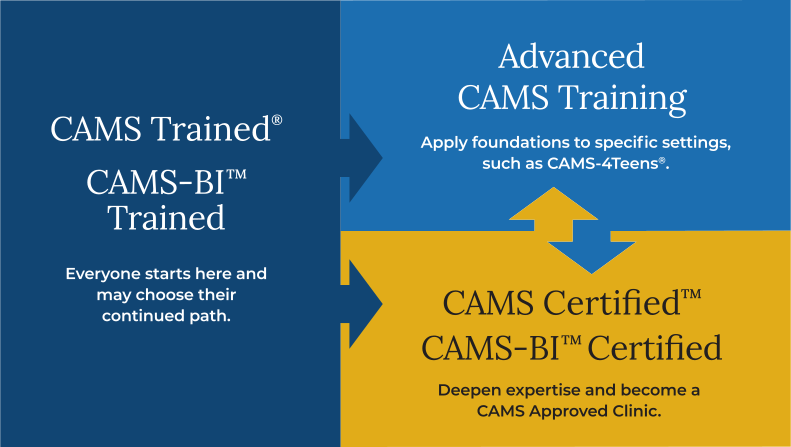
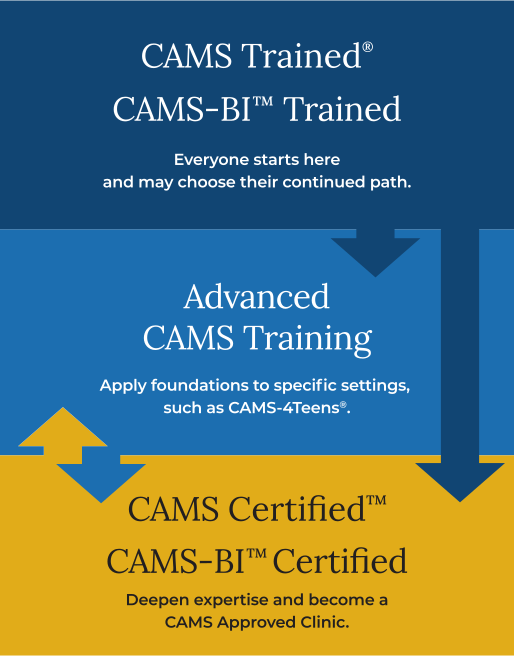
The CAMS-Care Training Pathway
Your journey to effectively treating suicidal risk starts now. And we’re in it with you — every step of the way.
All training begins with CAMS Trained. Learn the foundational skills and knowledge to prepare you to save lives, starting with your first patient.
Advanced CAMS Training can be done after you are CAMS Trained and before or after you are CAMS Certified.
Become CAMS Certified after you’ve achieved CAMS Trained status. Deepen your expertise and become a CAMS Approved Clinic or continue with Advanced CAMS Training.
Frequently Asked Questions
Mental health providers in individual therapy, emergency departments, and inpatient and intensive outpatient programs (including telehealth) benefit greatly from CAMS. Our training is also appropriate for case managers and social workers, school counselors, administrators, and emergency or crisis responders—especially those who make risk determinations and do safety planning. Lastly, we strongly encourage students practicing under supervision in the above areas to learn and use CAMS.
- The CAMS Book, Managing Suicidal Risk, a Collaborative Approach 3rd Edition
- Foundational Video Course
- Role-Play Training
- Consultation Calls
- Free Foundational Knowledge Test or Foundational Video Course CEs
Research has shown that clinicians can become adherent in the use of CAMS with their first patient within four sessions.
Dr. Jobes has been involved in the Zero Suicide movement since its inception. CAMS is a key part of Zero Suicide initiatives, recognized as one of the few evidence-based approaches to treating suicidal risk. Please feel free to contact Training & Implementation for a free initial consultation with one of expert consultants on integrating CAMS into your Zero Suicide system of care.
Yes, many organizations opt to complete foundational training in CAMS by having staff read the book, take the Foundational Video Course, and attend a series of consultation calls. We have also split our online Role-Play Training into half-day sessions to accommodate organizations’ needs.
Please complete our inquiry form, and we will be happy to contact you to discuss the available options.
Recent Resources

Feasibility of Collaborative Assessment and Management of Suicidality–Brief Intervention in...
This pilot feasability study tested CAMS-Brief Intervention (CAMS-BI), a single-session suicide intervention, with 20 suicidal...

Validating the Suicide Status Form for the Collaborative Assessment and...
This study tests whether the Suicide Status Form (SSF-IV) — the core assessment tool used...
Zero Suicide: What about “Treat”?
In this Crisis-The Journal of Crisis Intervention and Suicide Prevention editorial, Julie Goldstein Grumet and...

Novel Telehealth Adaptations for Evidence-Based Outpatient Suicide Treatment: Feasibility and...
This Healthcare study evaluates Crisis Care, a telehealth-adapted version of the CAMS Framework®, delivered to...

An observational pilot of the collaborative assessment and management of...
Can a single 60-minute session make a meaningful difference for inpatients experiencing suicidal thoughts and behaviors?...

Suicide Prevention in K-12 Schools: Introduction to the Special Issue
School-based mental health partnerships are vital for youth suicide prevention, especially in rural areas with...