SUICIDE CARE TRAINING FOR TEAMS OF 5 OR MORE
CAMS for Organizations
Give your clinicians one shared, evidence-based approach to suicide care. We train teams in hospitals, clinics, schools, military and veteran health centers, tribal nations, and more, and help you plan a rollout that fits how you already work.
Find training built for your setting
Children’s Hospitals
Implement an effective approach to pediatric suicide prevention with CAMS—an evidence-based, suicide-focused, solution designed to work in children’s hospital settings.
Emergency Departments & Hospitals
Provide clinical suicide treatment training to your emergency staff by implementing a hospital protocol for suicidal patients using CAMS.
School Districts

Provide your staff with an effective approach to youth suicide prevention. CAMS training is an evidence-based solution focused on suicide. It is designed to support suicide prevention efforts in school districts.
Military & Veterans

Help save lives by providing an evidence-based suicide treatment solution to military and veterans with CAMS, the Collaborative Assessment and Management of Suicidality.
State & Local Agencies

CAMS collaborates closely with state and local suicide prevention foundations and organizations to develop tailored training programs that address unique challenges faced by the populations they serve.
Students & Educators

If you’re an educator, the director of a college counseling center, a behavioral healthcare provider on campus, or a student, learn how to integrate CAMS on campus through education materials.
Tribal Nations

Equip your community with an evidence-based approach to treat tribal members with serious thoughts of suicide using the CAMS Framework®.
Universities

Support your university counseling center staff with CAMS training to provide students with quality, evidence-based care that helps save lives.
Correctional Facilities

Learn how the CAMS Framework® can support staff at correctional facilities in helping incarcerated individuals who are struggling with serious thoughts of suicide.
Are you an individual clinician or looking for training for groups of 4 or fewer?
Visit the Individuals & Small Groups page to learn more about how to get started quickly with the CAMS Framework®.
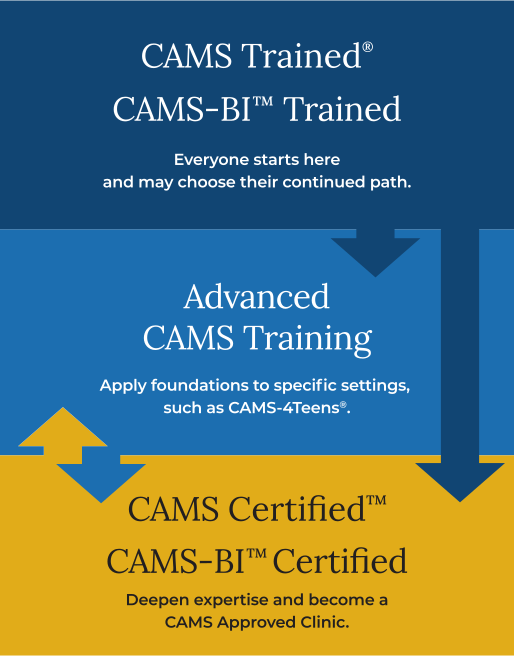
The Recommended Learning Path for Organizations
Your team starts with a shared foundation. Choose the training that fits where your clinicians see patients.
CAMS Trained®
For outpatient and ongoing care teams, like community mental health centers, counseling centers, and behavioral health clinics. Your clinicians learn the full CAMS Framework® to assess and treat suicide risk across multiple sessions.
CAMS-BI™ Trained
For emergency departments, crisis stabilization, EmPATH units, and inpatient care. CAMS Brief Intervention gives your staff a structured, one-session approach. Patients leave with a stabilization plan, a treatment plan, and a referral to outpatient care.
As your program grows, Advanced CAMS Training helps your team apply CAMS to specific populations, including CAMS-4Teens®. Supervising CAMS builds supervisors within your organization who can support clinicians and keep care consistent. Clinicians can then earn their CAMS Certified™ or CAMS-BI™ Certified designation, and your organization can become a CAMS Approved Clinic.
Bring CAMS to your organization.
Groups of 5 or more work with our team to build a training plan that fits your setting, staff, and goals. Discounts are available for groups of 50 or more.
Training 4 or fewer? Visit Individuals & Small Groups.
I keep citing the research you all have shared about how CAMS increases the confidence of the therapist, and I can attest to that personally. It was a game changer for me. I want to do all I can to continue to push our adoption and save lives!
– Lori Libel, LSCSW, LCAC, CQM/OE
Deputy Chief, Crawford County CMHC
For over six years, the Ohio Suicide Prevention Foundation (OSPF) has continued to invest in the CAMS-Care model because we believe mental health professionals benefit tremendously from this life-saving therapeutic framework that addresses the specific suicidal drivers of clients.
– Austin Lucas, OCPSA
Associate Director, Ohio Suicide Prevention Foundation
CAMS Trained™ Organizations
Frequently Asked Questions
CAMS for organizations refers to implementing the Collaborative Assessment and Management of Suicidality (CAMS) across a healthcare system, clinic, or institution to standardize suicide-focused care. It provides a structured, evidence-based framework that clinicians can use to assess, treat, and document suicidal risk collaboratively with patients. Organizational adoption often includes staff training, workflow integration, and ongoing consultation. Learn more about the CAMS Framework® at FAQ.
Implementing CAMS across a healthcare system typically involves training clinicians, aligning documentation practices, and integrating the framework into existing clinical workflows. Organizations often begin with pilot programs before expanding system-wide to ensure consistency and sustainability. Leadership support and clinical supervision are key components of successful implementation. Learn more about CAMS training.
CAMS is used by a wide range of organizations, including hospitals, community mental health centers, private practices, university counseling centers, and government agencies. It is adaptable to different care settings, including outpatient, inpatient, and crisis services. Organizations adopt CAMS to create a consistent, suicide-focused approach to care. Learn more about the CAMS Framework® at FAQ.
Organizations typically engage clinicians in formal CAMS training, which may include online courses, role-play practice, and consultation. Training ensures that providers understand how to use the framework consistently and adhere to its core principles. Many organizations also incorporate ongoing supervision to support fidelity to the model. Learn more about CAMS training.
CAMS is designed to integrate into existing clinical workflows without requiring a complete overhaul of current systems. It can be incorporated into standard assessment, treatment planning, and documentation processes with appropriate training and support. Many organizations adapt CAMS to fit their specific operational and regulatory requirements. Learn more about the CAMS Framework® at FAQ.