Your district already screens for suicide risk and trains staff to spot it. CAMS gives your counselors, psychologists, and social workers what comes next: an evidence-based way to assess and treat that risk directly, inside the policies, staffing, and tiered system you already have.
Inquire About Training
Training is available for:
- School counselors
- School psychologists
- Social workers
- School nurses
- Supervised graduate staff
- Student services
- Staff and supervisors
The Gap Districts Keep Running Into
Screening and awareness programs do what they were designed to do: they surface risk. What they were never designed to do is treat it. So when a student is identified, too many schools have only two options: send them home, or send them to an emergency department. Fewer than 1 in 5 students follow through on an outpatient referral.
Districts vary widely in staffing, policy, and what counselors are permitted to do, so the answer can’t be one more program layered on top. It has to fit the system already in place. That’s what CAMS is built to do.
Journal
Asking About Suicide Doesn't Increase Risk. It Enables Early Intervention.
Decades of school-based research point the same direction: asking students directly about suicide does not plant the idea. It makes early intervention possible.
That same research is clear that awareness alone isn’t enough. Districts need tertiary supports like CAMS, and partnerships with researchers and community providers to sustain them, especially in rural areas where access is thinnest.
Kurt D. Michael, PhD, and Amy M. Brausch, PhD. “Suicide Prevention in K-12 Schools: Introduction to the Special Issue.” School Mental Health, 2026.
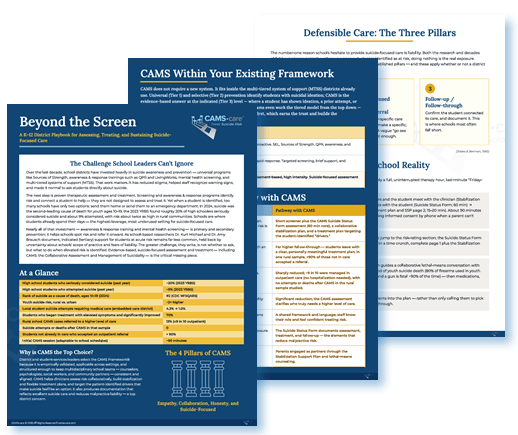
Beyond the Screen
A K-12 District Playbook for Assessing, Treating, and Sustaining Suicide-Focused Care
Your district already screens for suicide risk and trains staff to recognize it. The harder question is what happens next.
This playbook shows how districts are closing the Tier 3 gap — treating suicide risk within the school day instead of defaulting to the emergency department. Inside: a side-by-side look at the current referral pathway versus a pathway with CAMS, the three pillars of defensible care, partnership models that build clinical capacity at any budget, and early results from districts already doing this work.
How CAMS Can Help
CAMS is a suicide-focused framework, which means the treatment targets the suicidality itself rather than treating it as a symptom of something else. Two tools carry most of that work.
The Suicide Status Form (SSF) is completed by the clinician and student together. The student rates and describes what is driving their suicidality in their own words, and that becomes the basis for the risk assessment, the treatment plan, and any referral for further care. Because the SSF is filled out collaboratively and updated every session, it also produces a clear record of what was assessed, what treatment was provided, and how the student responded over time. That gives your district documentation reflecting the care actually delivered, not just the fact that a concern was noted.
The Stabilization Support Plan is built with the student and their caregivers. It sets out concrete steps for the days between sessions and includes a lethal-means conversation covering firearms, medications, and other methods in the home, so families leave with a plan rather than a warning.
Benefits of Clinical Suicide Prevention Training for School Teams

Adaptable Framework
CAMS is a framework, not a script. It centers on what the student says is driving their suicidality, which is why it works across settings, ages, and clinical orientations. Your staff keep the evidence-based approach they already practice, whether that’s DBT, CBT, or ACT, and CAMS gives them a shared structure for assessing risk and building treatment around it. It also flexes to district reality: policy limits on what counselors are permitted to provide, uneven staffing across buildings, and schedules that rarely allow an uninterrupted hour.
Defensible Care, Documented
Once a student is identified as at risk, doing nothing is the real exposure. Defensible care rests on three well-established pillars: a genuine assessment establishing that risk is present, suicide-specific treatment or a warm, named referral rather than a vague “go see someone,” and confirmed follow-up documenting that the student actually connected to care. CAMS builds all three into the clinical workflow, and the Suicide Status Form produces that documentation as a by-product of the care itself.

Effective Right Away
CAMS engages youth immediately by helping them identify suicidal drivers and equipping them with a plan for moving forward. This means that even with a limited number of sessions, it can have a lasting impact. The initial session runs about 90 minutes and can be re-sequenced around bell schedules, staffing, and parents who can’t come in, including consent by phone.

Shared Language
In a district, a student at risk is rarely held by one person. A school counselor, a psychologist, a social worker, a building administrator, and often a community mental health or hospital partner all touch the same case, and the student moves between buildings and grade bands over time. When your team is trained in CAMS, they assess against the same form, describe risk the same way, and can pick up a case without starting over.
School Districts Trained in CAMS



How CAMS Training Works
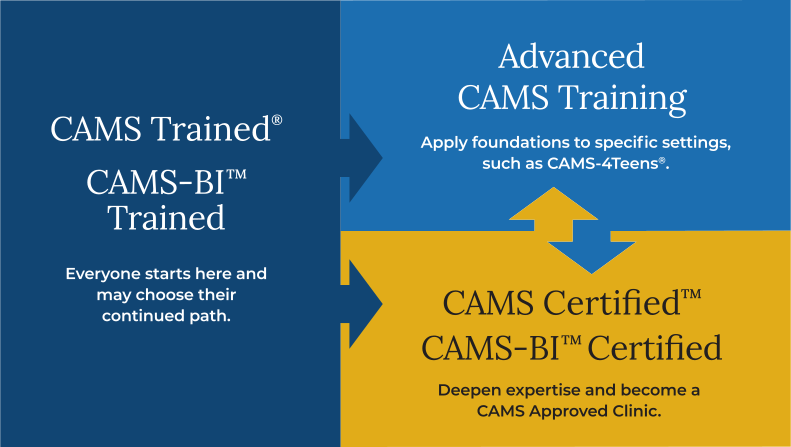
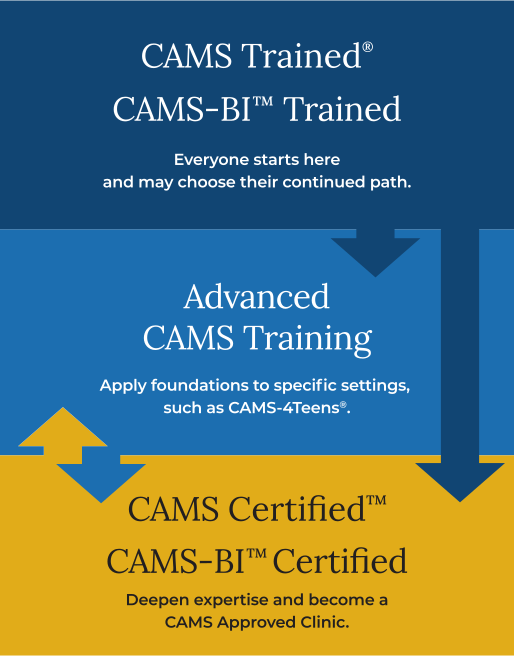
CAMS offers clinical suicide treatment training for those who are working with students. We recommend that providers first become CAMS Trained. After receiving the CAMS Trained designation, you and your team can enroll in Advanced CAMS training programs that take your CAMS knowledge further. At CAMS-care, we also offer consulting services. We can help you understand how to start policy changes. Additionally, we provide guidance on implementing CAMS into your school district.
CAMS-care has transformed how our school-based mental health providers support students in crisis. Instead of defaulting to hospitalizations, we’re now able to meet teens where they are — safely, compassionately, and within their school community. The CAMS process not only helps students assess and gain distance from painful thoughts, it naturally flows into individualized treatment planning aligned with each practitioner’s evidence-based approach, whether DBT, CBT, or ACT. We’re so encouraged by its impact that we partnered across counties to train even more school-based clinicians in our rural Michigan communities.
Jennifer VanTol, M.Ed, BCBA, MI-LBA. OTRL
Whole Child Systems Coordinator
Tuscola Intermediate School District
Frequently Asked Questions
Many districts assume referring out is the safer choice legally. In practice, once a student has been identified as at risk, doing nothing is the greater exposure, and referrals frequently go unused: fewer than 1 in 5 students follow through on an outpatient referral. School counselors, psychologists, and social workers who are licensed to provide mental health services can be trained to assess and treat suicide risk within their scope of practice, and CAMS-4Teens® adapts that work specifically for adolescents. Scope of practice varies by state and by district policy, so the practical first step is confirming what your licensure and board policy already allow.
Effective programs are layered and consistent. Universal education reduces stigma, staff training helps adults recognize warning signs, and screening surfaces students who are struggling. What separates strong programs is what happens next: a defined pathway from identification to assessment, treatment, and confirmed follow-up, with a named owner for each step. Prevention works best when it’s part of a school’s ongoing rhythm rather than a one-time initiative, and when the district has decided who does what before a crisis rather than during one.
Training generally falls into three layers. Awareness education for students and staff builds shared understanding. Gatekeeper programs such as QPR and LivingWorks teach teachers, coaches, and support staff to recognize warning signs and refer. Clinical training prepares school counselors, psychologists, and social workers to assess and treat suicide risk directly. Most districts have invested well in the first two layers. The third is where gaps remain, and it’s where evidence-based clinical frameworks like CAMS are used.
Start with the people most likely to be first contact when a student is identified: school counselors, school psychologists, social workers, and supervised graduate staff. CAMS-BI™ prepares them to provide a therapeutic assessment. Clinicians who will carry ongoing treatment take the full CAMS Framework®, and CAMS-4Teens® adds adolescent-specific adaptations. Districts often designate CAMS Certified™ staff as internal champions, and larger districts develop Internal Trainers who can train new hires as the team changes.
The initial CAMS session runs about 60 minutes with the student. In a school setting it’s usually bracketed by shorter meetings with caregivers, roughly 15 to 20 minutes before and after, for stabilization planning and the treatment plan. Every piece can be re-sequenced around bell schedules, staffing, and family logistics, including informed consent by phone when a parent can’t come in.