
Improve suicide-specific outcomes through flexible, scalable and affordable training solutions.
Inquire About Training
Training is available for:
- Clinical staff & behavioral health providers
- Crisis and emergency department teams
- State & county agency employees
State and local agencies face distinct challenges in addressing suicide risk — navigating fragmented care systems, serving diverse populations, and building workforce capacity at scale. CAMS training is designed to meet agencies where they are, with flexible delivery options and a platform that allows organization leaders to track staff progress and CAMS Designations earned.
CAMS has supported state-level suicide prevention initiatives across the country, including in Oklahoma, Ohio, Vermont, Massachusetts, New Mexico, Utah, and Colorado — several of which are recognized in the 2024 National Strategy for Suicide Prevention. Thousands of providers across care systems and mental health disciplines have completed CAMS training, and clinicians in participating states are listed on the CAMS Clinician Locator, helping connect people in crisis to treatment with a proven evidence base.
In the clip below, Lena Heilman of the Colorado Office of Suicide Prevention describes how Colorado built a statewide, comprehensive approach to suicide care — and what other state and local agencies can learn from their experience.
Case Study
How the Oklahoma Department of Mental Health uses CAMS for Suicide Prevention
Learn how the Oklahoma Department of Mental Health and Substance Abuse Services is successfully treating suicidal patients with the CAMS approach.
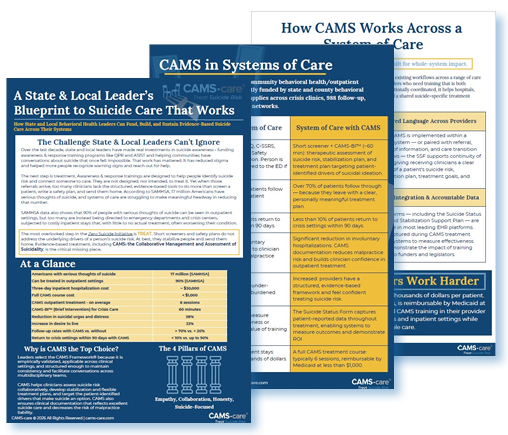
A State & Local Leader's Blueprint to Suicide Care That Works
State and local behavioral health systems are under increasing pressure to address suicide risk across distributed provider networks — often with inconsistent clinical capacity, competing funding priorities, and limited pathways from crisis to treatment. A State & Local Leader’s Blueprint to Suicide Care That Works outlines a clear, evidence-informed approach to building suicide-specific treatment infrastructure across state and county systems using the CAMS Framework®.
Download this guide to learn how state and local leaders are building shared clinical capacity across the full care continuum — from 988 and crisis lines, emergency departments, and crisis stabilization units to CCBHCs, FQHCs, outpatient therapy, and telehealth.
State & Local Agencies Trained in CAMS




The Colorado Office of Suicide Prevention: A Leader in Comprehensive Suicide-Specific Care
Since 2018, CAMS has partnered with the Colorado Office of Suicide Prevention (OSP) to implement a state-wide, comprehensive approach to treating suicidal risk.
Focusing on six core pillars—Connectedness, Economic Stability, Education and Awareness, Improving Access to Safer Suicide Care, Lethal Means Safety, and Postvention—OSP leverages competitive federal grants and state general funds to strategically develop and implement equitable strategies that effectively reduce suicidal despair, attempts, and deaths across Colorado.
Incorporating CAMS trainings and promoting the Zero Suicide framework have helped OSP achieve system-wide transformation of health care settings toward safer suicide care for all of Colorado.

The 2024 National Strategy for Suicide Prevention highlights OSP’s work as a model for supporting upstream comprehensive community-based suicide prevention.
Are you a government agency inspired by Colorado’s impact? Do you want to replicate their approach?
We’d love to support you.
Dr. Jobes and the CAMS-Care team provide the most cutting-edge, evidence-based suicide risk-assessment and treatment framework for clinicians, counselors, social workers, and other relevant professionals. Our Ohio CAMS-trained behavioral health professionals are now equipped with the skills and documentation necessary to create an effective treatment plan which can potentially keep the client out of the hospital.
Austin Lucas
Ohio Suicide Prevention Foundation
Include CAMS Training in Your Grant
As awareness of the need for suicide prevention grows, more state and local agencies are receiving grants to fund trainings, including the Garrett Lee Smith and Zero Suicide grants from the Substance Abuse and Mental Health Services Administration (SAMHSA).
The CAMS Approach to assessing and treating suicide risk meets the criteria for most of these grants. Explore federal, state, and local funding opportunities and CAMS-related resources to help complete your grant applications.
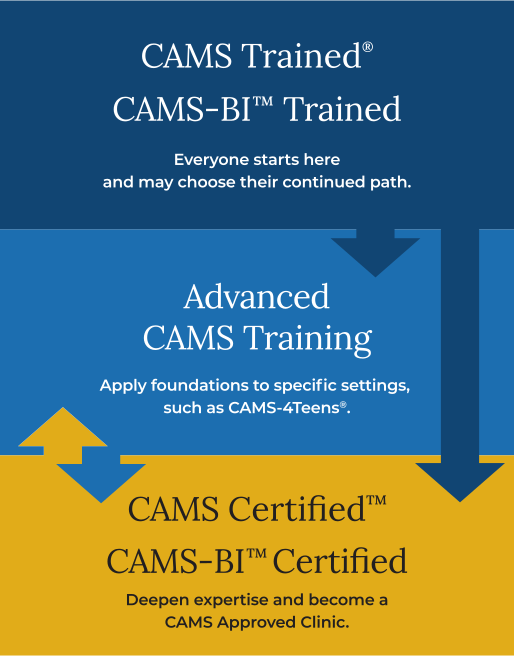
How CAMS Training Works
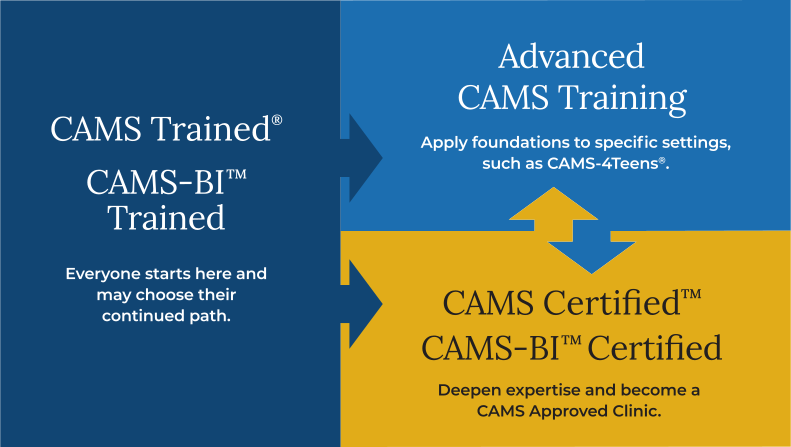
CAMS offers training designed to be used in children’s hospitals’ emergency departments and in-patient settings. We recommend that providers become CAMS Trained followed by Advanced CAMS training programs such as CAMS-4Teens and CAMS Brief Intervention (CAMS-BI)
CAMS-BI is a training specifically designed for those working in emergency departments and hospitals. When using CAMS-BI, you help set young patients up for success by creating a personalized treatment plan and referral for outpatient care. These shorter, one-hour consultations have quick impact. 58% of patients say they feel less distress afterwards. They also report feeling more motivated to live.
Frequently Asked Questions
Yes, we would love to arrange for a consultant to visit your organization for a role-play training. Please complete the inquiry form and we will be happy to contact you. In response to COVID-19, we now provide group and individual Online Role-Play Training using the Zoom platform with Zoom Breakout Rooms for role-play sessions.
Yes, we have trained groups of less than ten attendees and we also encourage you to sign up multiple individuals to the Online Role-Play Training. Please complete our inquiry form with information about your organization and we will be happy to contact you to discuss the options available.
CAMS-care provides the only authorized training in CAMS that readily fits well into a Zero-Suicide policy effort. Dr. Jobes has been involved in the Zero Suicide movement since its inception and CAMS is consistently used within Zero Suicide initiatives as one of only a handful of suicide-specific evidence-based approaches to suicidal risk according to replicated randomized controlled trials.
Yes, CAMS is an excellent evidence-based suicide-specific clinical intervention that can be well-suited for suicide prevention efforts funded by GLS. Many CAMS trainings have been conducted for state organizations and Native American behavioral health providers.
Yes, we offer discounts for groups of more than 50 and for groups of more than 100. Please complete our inquiry form and we will be happy to share them with you.
At this time we are not able to offer discounts for groups of less than 50.