
Grow your skills and confidence as you start your career. CAMS is an evidence-based framework. It helps patients who are struggling with suicidal ideation.
Training is available for:
- Graduate students
- Students in professional training programs
- Students receive a discount of 65% off CAMS training costs
Feel Confident Putting Your Skills to Use
Graduate schools provide valuable and necessary education to those who are going into the mental health field. However, graduate school education around working with and treating patients who are suicidal is limited. Students want to feel confident as they begin working with patients. They also want a strong resume as they apply to jobs. Additionally, schools want to provide graduate students with a well-rounded education but may struggle with resources for teaching about suicide treatment. This is where CAMS can help.
Case Study: Eastern Kentucky University
At Eastern Kentucky University, graduate students of Dr. Melinda Moore have been learning and using CAMS in their psychology clinic. Many students have expressed that CAMS training helped them gain confidence. They feel better equipped to work with at-risk individuals who are struggling. It has also provided them the tools they need as they start their careers.
How CAMS Can Help
CAMS is an evidence-based framework. It focuses on suicide risk. It helps clinicians accurately assess suicide risk. CAMS also provides a clear path forward for treatment. It has been found to resolve suicidal ideation in as few as 6–8 sessions. CAMS training is available for graduate students at a reduced price. Lectures and demonstrations of CAMS can also be integrated into classroom settings. They can be added on to existing courses in psychology.
Benefits of CAMS Training for Graduate Students

Cost-Effective Training
Students receive a significant discount on all CAMS trainings, making graduate school the perfect time to become CAMS Trained™.

A Community of Support
When you sign up for CAMS training, you won’t be alone. You will be joining a community with resources available to help you answer questions or concerns that may arise.
Reduces Malpractice Risk
CAMS reduces the risk of malpractice due to its use of the Suicide Status Form which provides protective documentation of suicide-focused care. This can help graduate students feel more confident and comfortable when using it to treat patients.

Shared Language
When CAMS is being used in a system of care, it creates a shared language. This language helps each provider who works with the patient moving forward. This helps ensure that the patient is getting the best care possible. It also makes sure that progress is being made on the issues that led them to consider suicide.
How CAMS Training Works
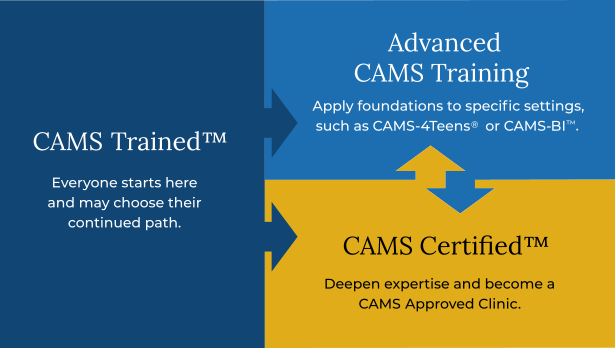
CAMS-care offers clinical suicide treatment training that graduate students can easily participate in along with their studies. We recommend that providers first become CAMS Trained™. After receiving the CAMS Trained designation, you can enroll in Advanced CAMS training programs that take your CAMS knowledge further.
As a clinician who has lost a loved one to suicide, I can vouch for CAMS being not only instructive but also personally healing in helping me feel like I CAN help people who think of suicide.
Evan Merida, MA, LPC, NCC
Sun and Shade Counseling, Denver, CO
The approach of sitting with a client’s thoughts of self harm without immediately jumping to hospitalization has led to better outcomes — both because I’m more confident to stay in that space with them and because that willingness creates a greater trust between us.
CAMS Trained Clinician
Frequently Asked Questions
Graduate students and school counselors learn to assess suicide risk, engage collaboratively with patients, and build individualized safety plans. Evidence-based training like the CAMS Framework® teaches them to understand the personal drivers of suicidal thoughts and document care effectively.
Common warning signs include withdrawal from friends, hopelessness, changes in sleep or appetite, giving away belongings, or expressing a wish to die. Any significant change in mood or behavior should prompt a caring, direct conversation and connection to support.
Confidence comes from structured, evidence-based training and supervised experience. CAMS provides a clear framework and language for assessing suicidality, developing treatment plans, and working collaboratively—helping students move from fear to skillful, compassionate care.
A safety plan is a personalized, written list of coping strategies, contacts, and actions a person can take during a suicidal crisis. CAMS integrates safety planning directly into treatment, co-created with the patient to strengthen ownership, hope, and follow-through.
Yes. Graduate students and counselors are mandated reporters when a patient is at imminent risk of harm to self or others. CAMS supports them by providing clear documentation tools and structured collaboration with supervisors and treatment teams, ensuring ethical and effective care.
Students receive a 65% discount off of the regular costs to get CAMS Trained.
Reasons a graduate student should consider CAMS training include:
- Suicide is one of the most difficult conversations students will navigate clinically
- Most students do not get suicide-specific training on assessment or treatment from their programs or sites
- Learning CAMS will make you more competitive for clinical placements and more confident in clinical contacts.
Contact CAMS-care to inquire about the CAMS-care training discount for students.