Malpractice Liability Related to Suicidal Risk: How to Decrease the Risk

Few clinical concerns frighten mental health providers more than the fear of being sued for malpractice related to working with suicidal patients.

In my professional life, I routinely train clinicians across the spectrum of mental health care. Over the past thirty years, I have trained thousand of mental health providers who practice in virtually all disciplines and treatment settings. As an Associate Director of Clinical Training in an APA-accredited clinical psychology training program, I have had countless opportunities to discuss the topic of suicide risk assessment and treatment with aspiring mental health providers. In all my years of teaching, training, supervising, and consulting, I have been struck by the concern that seemingly affects all types of mental health providers: the fear of malpractice liability pertaining to clinical work with suicidal patients.

Mental Health Providers Want to Know “How Do I Not Get Sued?”

Recently, I presented at a psychiatric grand rounds at a prestigious medical center. As often is the case with such engagements, I had a series of meetings with young mental health providers at this facility – psychologists, clinical social workers, and psychiatrists. In one meeting, I was introduced to a group of young providers, and they were invited to ask me “anything under the sun” about clinical work and suicide risk. After going around the room, the single most pressing question, by far, was, “How do I not get sued if a patient of mine takes their life?” We had an hour to talk about any topic related to clinical suicide prevention, and yet we spent fifty minutes talking about how to avoid getting sued.

This example underscores perhaps the most problematic aspect of the fear of malpractice liability related to treating suicidal patients. Namely, that mental health clinicians can easily become preoccupied with the perceived threat of malpractice and thus resort to defensive practices. In adopting a defensive posture, one may come to see the suicidal patient as a threat to one’s professional livelihood. Within this dynamic, the patient (and potentially the patient’s family) may seem like the enemy—an adversary who is ready and eager to sue if treatment goes south.

Fatal Suicide Outcomes Are Often Viewed as Malpractice

Early survey data has shown that when there’s a fatal suicide outcome of someone engaged in mental health care, the majority of family members studied considered the death of their loved one as an obvious case of malpractice. Indeed, within this survey, 25% of family members of people who had died by suicide contacted an attorney to pursue litigation for malpractice.

Reflecting on the topic of mental health provider malpractice, it is interesting to note that, within our culture, there is not the same routine presumption of negligent liability with other fatal outcomes following health care treatment. Certainly, with egregious examples, malpractice litigation is considered (e.g. a surgical procedure in which a surgical tool is left in the body). But despite the fact that we live in a highly litigious society, malpractice lawsuits are not routinely considered across health care delivery as they are in cases of suicide. There is one notable exception: Fatalities in childbirth that occur during delivery also often prompt the assumption of negligent malpractice. As a society, apparently, there is little tolerance for care that fails to prevent a self-inflicted death or the loss of an infant during childbirth. Even if the care provided was competent or heroic, a lawsuit might well be considered and pursued.

Fear of Malpractice Can Change the Way You Practice

In describing the topic of malpractice liability, I do so in full recognition that any death is a personal and family tragedy. But the concern that I am presently raising is how the fear of malpractice litigation can potentially paralyze an otherwise conscientious provider – leading to the proverbial deer in headlights. Such paralysis can lead to defensive practices in mental health care that might decrease the apparent exposure to malpractice risk but may have little to do with what is actually in the patient’s best interest.

As I have written about elsewhere, defensive practices within mental health can often lead to the overuse of inpatient psychiatric hospitalizations. Because of fear of malpractice, this type of “better safe than sorry” rationale often comes into play for patients who do not necessarily need this level of intensive intervention. In addition, there is often an overreliance – even a kind of wishful thinking – related to prescribing psychotropic medications to treat underlying psychiatric disorders of suicidal people. Despite the fact that the literature supporting the use of medicine to treat suicidality is limited or mixed at best, malpractice-related concerns may compel pursuing options that are extreme or ineffective.

If defensive practice is not the best way to avoid a malpractice suit, what is?

Definition of Malpractice in Mental Health Care

The answer to this question lies in understanding what constitutes malpractice. Briefly, malpractice is a tort action wherein a plaintiff (typically a surviving family member of someone who has died by suicide) engages a lawyer to argue that the defendant (the mental health provider) insufficiently met the “standard of care” and that what the provider did or did not do was a direct or proximate cause of the fatal outcome.

The standard of care for mental health providers is defined on a case-by-case basis by expert witnesses who attest to what a similarly trained clinician (with a similar case and in a similar setting) would do. An expert witness is hired by the plaintiff’s attorney to argue that the defendant did not meet this standard of care. The burden of proof lies with the plaintiff. In turn, the defendant’s lawyer hires their expert witness who argues that the mental health provider actually did meet the standard of care.

What ensues is an unpleasant process of discovery of records and relevant documentation, interrogatories, and depositions of the major parties within the case. Many, if not most, malpractice cases do not make it to trial—they get dropped or settled—yet the process of litigation can be traumatic for the defendant.

How to Decrease Your Potential Exposure to Suicide-related Malpractice Liability

More than twenty-five years ago, I published a journal article about how mental health providers can decrease their exposure to malpractice liability related to suicide. The glib answer was, and is, to save every suicidal patient! In reality, tragically, this is not always possible.

What one can do, however, is provide the best possible care, which is both suicide-specific and well-documented. This can be readily accomplish in your routine clinical practice by developing and adhering to “usual and customary practices” that focus on four key pillars of competent clinical care for suicidal patients.

These key pillars are:
1) Routinely and thoroughly assess for suicidal risk, and document that risk within the ongoing medical record.
2) If your patient is suicidal, there should be a sufficient focus on suicidality within the treatment plan, the use of a stabilization plan, and ongoing discussions about lethal-means safety.
3) As a competent mental health provider, you cannot “drop the ball” on the topic of suicide within the ongoing course of care. This means that the issue of suicide should be routinely assessed, treated, and well-documented.
4) You need to seek consultation on cases of potential suicide and document the consultative input.

Fatal suicide outcomes in mental health care are difficult for everyone involved, including families, providers, and organizations. But such outcomes are not necessarily legitimate grounds for malpractice litigation. There is no guarantee that by following these relatively simple steps, you will not be sued in the event of a fatal suicide outcome. But such routine practices can reduce one’s risk of malpractice exposure to negligible levels. This is because plaintiff attorneys take malpractices cases on contingency, which means they do not make a great deal of money unless they win or settle the case.

Skip Simpson, one of the nation’s leading plaintiff attorneys, has noted that if mental health providers follow the steps listed above and diligently document their practices, there is little incentive for malpractice lawyers to pursue litigation. Why? Because if a provider does follow these steps, the central litigation question becomes: Where was the negligence? Mental health providers are not expected to be mind readers or miracle workers, with unlimited control over the behaviors of their patients. But they are expected to be competent and to meet or exceed the standard of care.

CAMS Integrates “Competent Care” into All Clinical Care

While mental health providers can readily follow the recommended steps described above, the use of CAMS ensures that these basic steps of competent care are “baked” into their clinical care practices. CAMS, which stands for “Collaborative Assessment and Management of Suicidality,” is an evidence-based approach for the assessment and treatment of suicidal risk.

While I have seen cases in which patients who received CAMS-guided care have died by suicide, I have never seen or heard of a successful case of malpractice against a provider who adherently used CAMS. I have in fact seen on a few occasions that the use of CAMS has directly discouraged the pursuit of malpractice litigation. More to the point, I have directly seen or heard about countless cases in which CAMS successfully helped suicidal patients walk back from the brink of self-destruction.

Within CAMS-care, all of the members of our team are dedicated to reliably providing the best possible mental health care for patients at risk of suicide. In most cases, that will result in saving a life and averting the hardship that befalls families—and providers—who lose someone to suicide.

About the Author

David A. Jobes Ph.D. ABPP

David A. Jobes Ph.D. ABPP
David Jobes, PhD, ABPP, is the founder of CAMS-care, LLC. He began his career in 1987 in the Counseling Center of the Catholic University of America, where he developed a suicide risk assessment tool for college students that evolved into CAMS. Dr. Jobes is now a Professor of Psychology and Associate Director of Clinical Training at Catholic; he has trained thousands of mental health professionals in the United States and abroad in evidence-based assessment and treatment of suicide risk and the use of CAMS.

About David A. Jobes Ph.D. ABPP

David A. Jobes Ph.D. ABPP
David Jobes, PhD, ABPP, is the founder of CAMS-care, LLC. He began his career in 1987 in the Counseling Center of the Catholic University of America, where he developed a suicide risk assessment tool for college students that evolved into CAMS. Dr. Jobes is now a Professor of Psychology and Associate Director of Clinical Training at Catholic; he has trained thousands of mental health professionals in the United States and abroad in evidence-based assessment and treatment of suicide risk and the use of CAMS.

The Gender Paradox of Suicide: How Suicide Differs Between Men, Women, and Transgender/Gender Diverse Individuals

Over the last 60 years, research in field of suicidology (the science of why people die by suicide) has produced a large body of knowledge, including identifying hundreds of risk factors and dozens of theories on cause. Multiple suicide prevention initiatives have also been tested during this time.

And while we’ve learned a lot, perhaps one of the most important aspects of study consistently present across the decades of research on suicide is what is commonly referred to as the gender paradox, or why men account for more suicide deaths than women. More recently, the question of gender in suicidal behavior has expanded to include transgender and gender-diverse (TGD) individuals. Here’s a look at the role gender plays in suicide.

What is the Gender Paradox of Suicide?

The traditional gender paradox of suicide is simple: Men die by suicide more often than women, even though women report thoughts of suicide more often and make more non-fatal suicide attempts than men. In fact, the data from research on the subject is quite striking.

CDC data demonstrates that men account for over 76% of suicide deaths in the United States each year. The CDC also found that there are 3.3 male suicide deaths for every female suicide death. In contrast, in research studies, women are two to three times more likely to discuss thoughts of suicide than men, and there are approximately three female suicide attempts per every one male suicide attempt.

Although rates of suicide are different across age groups (e.g., middle-age and older adults die by suicide more than younger adults) and race/ethnicity (e.g., non-Hispanic White and Indigenous individuals die by suicide more than people of Hispanic ethnicity and/or Black racial identity), the gender paradox remains true across other demographics.

These data points demonstrate a simple truth: men die by suicide far more than women, but women experience thoughts of suicide and attempt suicide more than men. So why does this gender disparity persist when it comes to suicidal thoughts vs suicidal behavior?

Why Do More Men Die by Suicide Than Women?

Certainly, answering this question would provide meaningful information on the broad nature of suicide. However, the findings from this line of research are far more complicated than the paradox itself.

One potential reason that men die more by suicide than women is that men, compared to women, appear to be more fearless of death and able to tolerate more physical pain. As such, they may have a higher capability of a lethal suicide attempt if thoughts of suicide develop. This understanding is fairly intuitive. If people do not fear death and can feel confident they can tolerate the pain associated with suicide, they may be more likely to follow through on a plan to die by suicide. This concept is a central component of the Interpersonal Theory of Suicide, which provides clear hypotheses about how the desire and capability for suicide develops and has been researched for almost 20 years.

This fearlessness of death and tolerance of pain may also explain one key finding within the gender paradox of suicide. Compared to women, men generally use more violent methods for suicide, such as suicide by firearm. For example, approximately 60% of male suicides are by firearm, whereas just over 30% of female suicides include self-inflicted gun violence. This finding is important, since suicide attempts by firearm result in death in nearly 90% of cases. With other suicide methods such as overdose, suffocation/hanging, and self-piercing/burning, death is the result in less than 10% of these cases.

This means that for many men, their first attempt at suicide is fatal, whereas women are more likely to live through a first attempt. In fact, less than half of men who die by suicide have a documented history of one or more previous suicide attempts, whereas well over 50% of women who die by suicide have attempted before.

Why Do Women Attempt Suicide More Than Men?

According to the American Foundation for Suicide Prevention (AFSP) women are 1.5 times more likely to attempt suicide than men. But why are suicide attempts so much higher in women while the mortality rate of suicide is 3 to 4 times higher in men? One potential answer lies in the different rates of deliberate self-harm (DSH) between men and women.

According to a Cambridge study on gender differences in suicide behavior, researchers found that DSH is more common in women. The study goes on to suggests that:

“Acts of DSH by females are more often based on non-suicidal motivation.” In females, the appeal function of DSH, whereby DSH is used to communicate distress or to modify the behavior and reactions of other people, seems more common. In males, DSH is more often associated with greater suicidal intent. It is interesting that in community samples, suicidal ideation is reported far more often by females than males and when DSH is found in men it more strongly correlates with suicide.”

Another important suicidal driver for women is major Depression. According to a Danish study, major depression is approximately “twice as common in females, and is known to underlie more than half of all suicides” which can potentially account for the increased rate of suicidal behaviors in women.

What About Transgender and Gender Diverse (TGD) People?

Although some of the above ideas may explain why the gender paradox of suicide exists, there is potentially a need to revise our understanding of the paradox as we begin to learn more about suicide in transgender and gender diverse (TGD) individuals. For the sake of terminology, the term TGD refers to individuals whose sex assigned at birth (“natal sex”) does not match their own feelings about their gender, or “gender identity.” In this way, people who were deemed to be a man at birth (male natal sex) but feel as though their gender is not male (a gender identity of female or neither male/female, etc.), would fit under the umbrella term of TGD.

Our field’s understanding of the gender paradox of suicide was developed when most scholars viewed gender as a male/female binary. It has only been since the late 2000s that scholars have investigated suicide in those whose gender identity do not match their sex assigned at birth.

What Do We Know About Suicide in TGD Individuals?

As with the “why does the gender paradox exist” question, the answer is not simple. Some research suggests that TGD individuals whose sex assigned at birth was female may be at slightly higher risk for thoughts of suicide compared to those who were assigned male at birth, while other research has found the opposite relationship. More consistently, suicidal thoughts appear to be more prevalent in those TGD individuals who perceive their gender as neither male nor female (sometimes referred to as “non-binary”) compared to transgender men and transgender women (TGD individuals who view themselves as the male or female gender that is incongruent with their sex assigned at birth).

Like the relationship between suicidal thoughts and sex assigned at birth, the relationships between suicide attempt history and the TGD aspects of gender are murky at best. For example, as mentioned above, in relationship to suicide attempts, some research has found higher lifetime rates of attempts in TGD individuals with a female sex assigned at birth as compared to male sex assigned at birth. A roughly equal number of studies have found no relationship between sex assigned at birth and suicide attempt history.

A similar lack of consistent findings has been seen in studies comparing suicide attempt histories in those who identify within and outside of the gender binary. Simply put, there currently is no consistent research regarding the relationship between suicide attempt history and both natal sex and current gender identity in TGD individuals.

Suicide Attempts vs. Suicide Deaths

As you may notice, the paragraphs above note relationships with suicidal thoughts and attempts, not death by suicide. In fact, a very clear lack of research regarding death by suicide in TGD individuals can be seen in the research literature. Why is this? This answer is fairly simple: National rates of suicide are most often calculated using death certificates filed in each state.

These death certificates are most commonly completed by coroners and other medical certifiers, many of whom may not know a deceased individual identified as TGD. Also, early versions of these certificates only allowed for binary male/female gender identification. Thus, we do not know how the gender paradox “plays out” in TGD individuals as it relates to death by suicide.

So what do we know about death by suicide in TGD individuals? First and foremost, we know it is prevalent – and likely more prevalent than suicide in those who identify with their sex assigned at birth (“cisgender”). A study of all veterans who were given a gender-related diagnosis in the Veterans Affairs healthcare system between the years 2000-2009 indicated that TGD veterans died by suicide at over two times the rate of the national average of veteran suicide, and over six times the rate of the general population. This research corresponds with death records review in Denmark that demonstrates a higher suicide rate in their TGD versus cisgender population.

This study published in the American Journal of Public Health in 2013 unfortunately did not contain additional information about sex assigned at birth or gender identity and relied on healthcare providers having asked questions regarding a gender-related diagnosis in order to have a record of TGD status in patient charts. Scholars argue that, because of these limitations, the estimates for suicide in TGD veterans may be underestimated.

Gender and Suicide Conclusions

For years, the gender paradox was quite simple: women think about and attempt suicide more than men, but more men die by suicide. This has been and continues to be true in basically all age groups and races/ethnicities.

Complexity to the paradox has been added over the last decade or so for two reasons:

  1. Scholars wanted to identify why this paradox existed
  2. Work with TGD individuals became more prominent.

It is likely that we will learn more over the next decades of research regarding why this paradox exists and if it can be extended to the understanding of suicide in TGD individuals.

Although it is simple in theory, the gender paradox is a great example of the complexity of why people die by suicide. There may be trends, risk factors, and consistencies across stories, but for those who die, there is great individual complexity in why and how. Although hundreds of risk factors play a role in predicting suicide, including sex assigned at birth and gender identity, the prevention of suicide in clinical settings will likely rely on far more than knowing basic demographic factors.

One’s own suicide story, reasons for living, reasons for dying, and visualized method of suicide are likely important and may only slightly be influenced by one’s sex assigned at birth/gender.

How CAMS Can Help

Clinical tools such as the Suicide Status Form (SSF), a critical component of the Collaborative Assessment and Management of Suicide (CAMS), exist to help providers and patients collaboratively determine one’s drivers for suicide that can be mitigated through intervention to reduce suicide risk. Regardless of a patient’s sex assigned at birth, gender, or even mental health diagnosis, the collaborative assessment of these individual factors may help clinicians and patients alike understand more about one’s suicide risk and how a future suicide attempt could be prevented. Recommendations for the integration of affirmative care practices into the CAMS Framework® have been published and can help guide providing CAMS to TGD individuals.

Learn more about how you can become CAMS Trained™ and CAMS Certified™ to provide an evidence-based suicide treatment framework with all of your patients, no matter their gender.

References:

  1. Centers for Disease Control and Prevention, Suicide rising across the US.
  2. National Center for Biotechnology Information, The interpersonal theory of suicide: A systematic review and meta-analysis of a decade of cross-national research. https://www.ncbi.nlm.nih.gov/pubmed/29072480
  3. Joiner, Ph.D., Thomas E., “Why Do People Die By Suicide” Lecture Video. https://www.youtube.com/watch?v=DESRIZtUIT4
  4. National Center for Biotechnology Information, Prevalence of gender identity disorder and suicide risk amount transgender veterans utilizing veterans health administration care. https://www.ncbi.nlm.nih.gov/pubmed/23947310

About the Author

Raymond P. Tucker Ph.D.

Raymond P. Tucker Ph.D.
Raymond is an Assistant Professor of Psychology at Louisiana State University (LSU) where he founded the Mitigation of Suicidal Behavior (MOSB) Laboratory in 2017. He also is a Clinical Assistant Professor of Psychiatry at Louisiana State University Health Sciences Center /Our Lady of the Lake Medical Center. He finished his Ph.D. in clinical psychology from Oklahoma State University in 2017 following his clinical internship at VA Puget Sound. Raymond's research broadly focuses on the enhancement of theoretical models of suicide and suicide risk assessment tools, particularly in underserved populations (e.g., Veterans, Transgender and Gender Diverse adults). Raymond began his tenure as a CAMS consultant in 2019 after receiving a state-level grant to implement CAMS across the Our Lady of the Lake Regional Medical Center in Baton Rouge L.A. He is a former board member of the American Association of Suicidology and is a current faculty member at the National Suicidology Training Center.

About Raymond P. Tucker Ph.D.

Raymond P. Tucker Ph.D.
Raymond is an Assistant Professor of Psychology at Louisiana State University (LSU) where he founded the Mitigation of Suicidal Behavior (MOSB) Laboratory in 2017. He also is a Clinical Assistant Professor of Psychiatry at Louisiana State University Health Sciences Center /Our Lady of the Lake Medical Center. He finished his Ph.D. in clinical psychology from Oklahoma State University in 2017 following his clinical internship at VA Puget Sound. Raymond's research broadly focuses on the enhancement of theoretical models of suicide and suicide risk assessment tools, particularly in underserved populations (e.g., Veterans, Transgender and Gender Diverse adults). Raymond began his tenure as a CAMS consultant in 2019 after receiving a state-level grant to implement CAMS across the Our Lady of the Lake Regional Medical Center in Baton Rouge L.A. He is a former board member of the American Association of Suicidology and is a current faculty member at the National Suicidology Training Center.

Challenges of Assessing and Treating Youth Suicide: A Solution in CAMS-4Teens®

The news of rising teen suicide rates is difficult to ignore. Every few months, the media reports on another study that documents how much teen suicide rates have increased in the past 20 years. Rates jumped from 6.8 deaths per 100,000 people in 2000 to 10.6 deaths per 100,000 people in 2017.1 Suicide is now the second-leading cause of death for 15- to 24-year-olds, with only motor vehicle accident deaths outnumbering it. Researchers have noticed trends in suicide rates among girls and young women increasing, as well as for young black men.1,2

Researchers and mental health professionals are struggling to identify causes for these trends and to quickly identify effective prevention and treatment strategies to address this major public health concern. While many research studies report on trends in rates among certain gender and ethnic groups, it is extremely difficult to identify causes for rising suicide rates. Our best educated guesses about this alarming trend relate to added stress caused by:

  • addiction in families (as seen in the opioid crisis),
  • the use of social media and the associated feelings of inadequacy, loneliness, and the pressures of “keeping up” with friends,3
  • lack of access to mental health resources in schools and communities,
  • lack of suicide-specific training for mental health professionals, and
  • evidence that the current generation of youth experience more depression, anxiety, and stress in general than prior generations4.

All of these issues combined with easier access of searching, finding, and being exposed to media that depict or offer information on suicide may be impacting the increase.

Obstacles to Treatment

A major obstacle to reducing the rise of suicide rates across all age groups is the lack of evidenced-based care available for individuals who are suicidal5. Funding for research on suicide treatment lags far behind other health issues. For decades, researchers and mental health professionals did not include suicidal individuals in studies that tested promising new treatments because it was considered too risky. These barriers have brought us to our current state of feeling far behind in terms of knowing what works best for treating suicide. The National Institute of Mental Health has identified research on suicide as an area of priority, and more studies are being funded to help evaluate what methods work best for prevention, screening youth for suicide risk, and finding the best possible treatments.6

There are many layers of prevention and treatment that can be implemented for youth suicide. Many states have suicide prevention centers within their public health departments, which are tasked with implementing prevention programs in communities and schools and training mental health professionals in their state on best practices for working with suicidal patients. Within schools, Signs of Suicide has been found to be an effective gatekeeper training program that teaches teens about recognizing suicide risk in their peers and the steps they should take to connect their friends with resources.7 The Good Behavior Game is a classroom-management system that is used for second-graders and focuses on minimizing aggressive and disruptive behavior, and amazingly has shown long-term reductions in suicidal behavior as kids move through adolescence.8

Existing Treatment Programs

From a treatment standpoint, few treatments specific to suicide exist that have been shown to provide best clinical care for suicidal teens. Cognitive Behavioral Therapy (CBT) and Dialectical Behavior Therapy (DBT) are both used for teens with suicide risk. CBT works well as a treatment for depression and anxiety-related disorders, and it can also be used to help someone understand their thoughts about suicide and their feelings of hopelessness.9 DBT specifically addresses self-harming behavior and teaches teens important coping skills to use in place of self-harm.10

Safety-planning interventions and crisis response plans are useful when used in conjunction with DBT or CBT, as they provide concrete steps for teens and their families to follow when the teen is in crisis or thinking seriously about suicide.11,12

Advantages of CAMS with Youth and Teen Suicidality

Collaborative Assessment and Management of Suicidality (CAMS) is a therapeutic assessment and treatment framework that combines all elements from these treatments into one approach. First, CAMS provides a thorough risk assessment in the first session and uses the Suicide Status Form (SSF) to gather valuable information about a teen’s current experience and overall suicide risk.

With CAMS, the entire assessment approach is collaborative. The therapist sits next to the teen (if they are comfortable with it), encouraging the feeling that they are literally on the same page. Because many adolescents may be hesitant or suspicious of the treatment process, CAMS emphasizes transparency and empathy. Instead of a therapist sitting across from the teen with a clipboard and taking notes (that the teen can’t see) while asking questions, the teen is either writing their responses on the Suicide Status Form themselves (first page), or they are watching the therapist write down their responses (second page). The therapist and the teen write the treatment plan together, identify the top two drivers together, and create the stabilization plan together.

We have seen the CAMS approach work very well with teens (CAMS-4Teens), both in our own practices and with consultation and case presentations from other clinicians, as well as in research. A recent study found that the Suicide Status Form works just as well for assessing teen’s suicide risk as it does with adults. Teens in the study were able to understand and rate constructs like psychological pain, hopelessness, and self-hate in a way that was helpful to determining their overall level of distress and suicide risk.13

Once the therapist and teen identify the top two drivers for the treatment plan, the therapist explains what the goals and objectives will be, and which interventions they will use to help achieve those goals. Many teens have some version of self-hate as a driver for suicide. Therapists can make simple goals of decreasing self-hate and identify interventions to target that driver. Examples of interventions may be CBT interventions for increasing self-esteem or behavioral activation for getting teens out of the house and connected to the community and causes they care about (e.g., mentoring younger kids, animal shelters, volunteer work). Furthermore, elements from CBT, DBT skills, problem-solving, interpersonal therapy, and many other methods can be integrated into the CAMS Treatment® plan to target and treat drivers.

Especially for teens in an acute suicidal state, sometimes it is extremely helpful to first identify the problem. The CAMS Assessment® provides a guided walk-through of the teen’s life at that moment, and if a particular stressor or issue is uncovered as being related to the current suicidal thoughts, it can be addressed quickly in treatment. Teens can be overwhelmed with situational factors that feel unsurmountable. We have observed CAMS to be very useful in breaking down these factors into more manageable pieces that the teen can then recognize as treatable.

Tips for Using CAMS with Teens and Adolescents (CAMS-4Teens)

We have assembled some general tips for using CAMS with teens that may be helpful. Before making any major modifications to the Suicide Status Form (SSF) for use with teens, we decided to test it in its existing form. Our hunches were correct: we discovered that CAMS does not need to be radically changed for use with youth (ages 12-17).13

However, other slight procedural recommendations are helpful to keep in mind. First, some youth may need slower pacing for the assessment. It may take more time to explain concepts like psychological pain and agitation. Also, it may take some time to think about how to explain these concepts in a variety of ways.

Second, if the assessment is taking longer than usual, it is beneficial to prioritize getting the stabilization plan completed and in place. As much as possible and practical, intensive outpatient treatment is the goal of CAMS. This is largely achieved by having a solid stabilization plan/safety plan in place. It is very helpful to identify any supportive adults in the teen’s life that they can list on their stabilization plan as someone they can contact in a crisis. You may need to be creative in identifying these adults (e.g., parents, older siblings, other relatives, coaches, pastors, school counselors, etc.).

Third, some youth may respond better with a “parallel assessment” in which you are still gathering the information for the SSF while they are engaging in some other activity (coloring, fidget toys, etc.).

The last tip is focused on how to work with parents and caregivers during the course of CAMS Treatment. It is essential that other adults in the teen’s life are aware of the stabilization plan, understand how to respond to the child in a crisis, and can help assure access to lethal means are limited. We recommend completing the SSF with just the teen present, and then inviting the caregivers into the session at the end to review the stabilization plan. Caregivers may have a wide variety of emotional reactions to their suicidal teen, and it’s important to provide education on suicide in general, and the process of CAMS. Parents and caregivers may need their own support via therapy or community support groups.

In Conclusion

Thus far we have confidence from recent research results that the SSF is appropriate for teens,13 and that CAMS is a promising evidence-based treatment for suicidal teens.14,15 We know that CAMS is an effective treatment for adults,16 and that many clinicians are using CAMS with youth ages 12+ with success.

Our consultants provide on-going support to clinicians using CAMS with teens, and the overwhelming response from clinicians has been positive. They describe CAMS as useful with all types of teens – from those who are very expressive and talkative as CAMS helps organize their thoughts and feelings, to those who may be more reserved as CAMS allows them to express themselves through the SSF without needing to verbalize everything.

The next phase of CAMS-4Teens research includes randomized clinical trials (RCT), which are the gold standard in treatment research, to gather more evidence for the effectiveness of using CAMS with youth. We see a bright future in which CAMS will be available as an evidenced-base intervention for suicidal youth, a group for which having effective treatment will make a big impact and save lives.

    1. Curtin, S. C., & Heron, M. (2019). Death rates due to suicide and homicide among persons aged 10–24: United States, 2000–2017. NCHS Data Brief, no 352. Hyattsville, MD: National Center for Health Statistics.
    2. Miron, R., Yu, K-H., Wilf-Miron, R., & Kohane, I. S. (2019). Suicide Rates Among Adolescents and Young Adults in the United States, 2000-2017. JAMA, 321, 2362-2364.
    3. Twenge, J. M. (2017). Have smartphones destroyed a generation? The Atlantic, https://www.theatlantic.com/magazine/archive/2017/09/has-the-smartphone-destroyed-a-generation/534198/.
    4. Twenge, J. M., Cooper, A. B., Joiner, T. E., Duffy, M. E., & Binau, S. G. (2019). Age, period, and cohort trends in mood disorder indicators and suicide-related outcomes in a nationally representative dataset, 2005-2017. Journal of Abnormal Psychology, 128, 185-199.
    5. Jobes, D. A., & Joiner, T. E. (2019). Reflections on suicidal ideation. Crisis, 40, 227-230.
    6. Research Prioritization Task Force. (2014). A prioritized research agenda for suicide prevention: An action plan to save lives. National Action Alliance for Suicide Prevention.

http://actionallianceforsuicideprevention.org/sites/actionallianceforsuicideprevention.org/files/Agenda.pdf

  1. Seltine, R. H., James, A., Schilling, E. A., & Glanovsky, J. (2007). Evaluating the SOS suicide prevention program: a replication and extension. BMC Public Health, 7, 161.
  2. Wilcox, H. C., Kellam, S. G., Brown, C. H., Poduska, J. M., Ialongo, N. S., Wang, W., & Anthony. J. C. (2008). The impact of two universal randomized first- and second-grade classroom interventions on young adult suicide ideation and attempts. Drug and Alcohol Dependence, 95 (s1), s60-s73.
  3. Stanley, B. Brown, G., Brent, D. et al. (2009). Cognitive Behavior Therapy for Suicide Prevention (CBT-SP): Treatment model, feasibility, and acceptability. Journal of the American Academy of Child and Adolescent Psychiatry, 48, 1005-1013.
  4. McCauley, E., Berk, M. S., & Asarnow, J. R. (2018). Efficacy of Dialectical Behavior Therapy for adolescents at high risk for suicide. JAMA Psychiatry, 75, 777-785.
  5. Stanley, B., & Brown, G. K. (2012). Safety Planning Intervention: A brief intervention to mitigate suicide risk. Cognitive and Behavioral Practice, 19, 256-264.
  6. Bryan, C. J., Mintz, J., Clemans, T. A., Burch, T. S., Leeson, B., Williams, S., & Rudd, M. D. (2017). Effect of Crisis Response Planning on patient mood and clinician decision making: A clinical trial with suicidal U.S. soldiers. Psychiatric Services, 69, 108-111.
  7. Brausch, A. M., O’Connor, S. S., Powers, J. T., McClay, M. M., Gregory, J. A., & Jobes, D. A. (2019, early on-line). Validating the Suicide Status Form for the Collaborative Assessment and Management of Suicidality in a clinical adolescent sample. Suicide and Life-Threatening Behavior. DOI: 10.1111/sltb.12587
  8. O’Connor, S. S., Brausch, A. M., Ridge Anderson, A., & Jobes, D. (2014). Applying the Collaborative Assessment and Management of Suicidality (CAMS) to suicidal adolescents. The International Journal of Behavioral Consultation and Therapy, 9, 53-58.
  9. Jobes, D. A., Vergara, G. A., Lanzillo, E. C., & Ridge-Anderson, A. (2019). The potential use of CAMS for suicidal youth: Building on epidemiology and clinical interventions. Children’s Health Care, 48, 444-468.
  10. Jobes, D. A. (2015). Managing suicidal risk: A collaborative approach (2nd edition). New York: Guilford.

About the Author

Amy Brausch Ph.D.

Amy Brausch Ph.D.
Dr. Amy Brausch is an Associate Professor of Psychological Sciences at Western Kentucky University where she founded the Risk Behaviors and Suicide Prevention Laboratory in 2011. She completed her Ph.D. in clinical psychology at Northern Illinois University in 2008, following her clinical internship at Utah State University Counseling and Psychological Services Center. Dr. Brausch’s research program broadly focuses on youth suicide risk assessment, prevention, and treatment. Specifically, her work has also focused on the overlap between nonsuicidal self-injury and suicide risk, the overlap between body image, disordered eating, and self-harm, and the role of emotion dysregulation in NSSI and suicide risk. Her work has been funded by the Kentucky Biomedical Research Infrastructure Network and the National Institute of Mental Health. Dr. Brausch has collaborated with Dr. Jobes on research related to CAMS-4Teens, including a validation study of the Suicide Status Form for adolescents. As a Senior Consultant with CAMS-care, LLC, Dr. Brausch has provided training in CAMS to mental health providers in the United States and Australia at community mental health centers, university counseling centers, school districts, and local and state mental health suicide prevention organizations.

About Amy Brausch Ph.D.

Amy Brausch Ph.D.
Dr. Amy Brausch is an Associate Professor of Psychological Sciences at Western Kentucky University where she founded the Risk Behaviors and Suicide Prevention Laboratory in 2011. She completed her Ph.D. in clinical psychology at Northern Illinois University in 2008, following her clinical internship at Utah State University Counseling and Psychological Services Center. Dr. Brausch’s research program broadly focuses on youth suicide risk assessment, prevention, and treatment. Specifically, her work has also focused on the overlap between nonsuicidal self-injury and suicide risk, the overlap between body image, disordered eating, and self-harm, and the role of emotion dysregulation in NSSI and suicide risk. Her work has been funded by the Kentucky Biomedical Research Infrastructure Network and the National Institute of Mental Health. Dr. Brausch has collaborated with Dr. Jobes on research related to CAMS-4Teens, including a validation study of the Suicide Status Form for adolescents. As a Senior Consultant with CAMS-care, LLC, Dr. Brausch has provided training in CAMS to mental health providers in the United States and Australia at community mental health centers, university counseling centers, school districts, and local and state mental health suicide prevention organizations.

4 Things that Can Go Wrong When Working with Suicidal Minorities

One thing that has become increasingly important in this contemporary age of diversity is the importance of tailoring programs to individual needs. Arguably, nowhere is this more important than in the field of suicide prevention and treatment.

Using a cookie-cutter approach to treatment with a suicidal person who is part of a minority community (such as racial and religious minorities, women, LGBTQ, etc.) further alienates the client, who most likely already feels marginalized by “the system”. It’s important for therapists and care providers to take the cultural and societal differences of minority groups into careful consideration when working with these individuals and in devising prevention and treatment plans for these valuable members of our society.

Here are four things that can go wrong when we fail to consider and understand cultural differences in suicidal minority clients.

#1: Misunderstandings Cause Confusion and Alienation

Since the dawn of time, different cultures have developed their own unique ways of life, including beliefs, values, behaviors, and methods of communication. Something as simple as unfamiliar terminology can cause the client and the provider to misunderstand each other.

Minority clients especially need to feel confident that their unique needs are understood to develop confidence in their care provider or therapist. We as providers should strive to understand where our clients are coming from and find common ground from which to work – especially when their societal norms differ from our own.

#2: Trust is Eroded

We all know that the bedrock of any therapy session is trust. Without it, our counsel can fall on deaf ears. Clients need to feel that they can rely on their therapist or care provider to have their best interests at heart.

But how can we really have a minority client’s best interests at heart if we don’t understand their heart?

Taking time to understand a client’s cultural background provides valuable insight into her needs and helps build a foundation of trust between you and your client.

#3: Suicidal Thoughts May Become Exacerbated Instead of Mitigated

Many minorities already feel alone in their thoughts and experiences – even mentally healthy ones.

When minority clients feel misunderstood and unsupported (especially by the very person that is charged with helping them), this can contribute to a feeling hopelessness and increased “otherness”. If a suicidal minority client feels further alienated as a result of their treatment, her thoughts of suicide may become even more prevalent.

#4: Treatment is Less Effective

We all want to feel like our efforts are succeeding, and that our work with those struggling with suicidal ideation or behavior is making a difference. However, when misunderstandings and a lack of trust exist between a client and his provider, even the most proven-effective prevention methods can fall flat.

Clients can sense when we simply don’t “get them.” As a result, they are less like to open up and share, which prevents us from providing the best care possible.

As professionals in the suicide prevention and treatment field, we need to become culturally aware of our more diverse communities’ specific needs in order to ensure that the work we do is effective and successful.

To avoid these pitfalls, it’s important to consider ways to “bridge the cultural divide” when working with minority clients who do not share our own experiences and identities.

For more information

To learn more about effective methods for working with suicidal minorities, read “5 Effective Approaches When Working with Minority Clients” by Tanisha Esperanza Jarvis, M.A.

About the Author

Tanisha Esperanza Jarvis M.A.

Tanisha Esperanza Jarvis M.A.
Tanisha Esperanza Jarvis received her B.A. in anthropology and sociology at Spelman College in 2015, where she also minored in Comparative Women’s Studies. While at Spelman, her research focused on integrating academia and social justice. As a Bonner Scholar and Social Justice Fellow her research work included preventative and interventional treatment of sexual trauma and LGBTQ and racial/ethnic minority research. She finished her M.A. in psychological sciences from The Catholic University of America (CUA) in 2019. Her research within the Suicide Prevention Lab (SPL) focused on integrating an international approach to CAMS research and treatment of suicidality within marginalized communities.

About Tanisha Esperanza Jarvis M.A.

Tanisha Esperanza Jarvis M.A.
Tanisha Esperanza Jarvis received her B.A. in anthropology and sociology at Spelman College in 2015, where she also minored in Comparative Women’s Studies. While at Spelman, her research focused on integrating academia and social justice. As a Bonner Scholar and Social Justice Fellow her research work included preventative and interventional treatment of sexual trauma and LGBTQ and racial/ethnic minority research. She finished her M.A. in psychological sciences from The Catholic University of America (CUA) in 2019. Her research within the Suicide Prevention Lab (SPL) focused on integrating an international approach to CAMS research and treatment of suicidality within marginalized communities.

One Size Does Not Fit All – Part 3: Effective Suicidal Assessment and Treatment

As discussed elsewhere, there are over 80 randomized controlled trials (RCTs) of treatments where suicide-related outcomes are the primary focus [20,62]. Within clinical science, RCTs are the gold standard of what has proven effective in a causal manner because of their reliance on experimental designs and a-priori hypothesis testing. RCTs that have replicated results, particularly when results have been replicated by independent investigators rise to the top of the list when we consider empirically validated interventions. There are a number of interventions that have shown promise in a single RCT, for example, the Attempted Suicide Short Intervention Program (ASSIP) and Mentalization-Based Therapy [63,64]. However, we will focus on treatments that have been replicated and have independent RCT support. These include four distinct treatments/interventions that have been shown to effectively target suicidality.

Dialectical Behavior Therapy Treatment

The most notable and heavily researched treatment that has been shown to reduce suicidal behaviors regardless of the intent to die, is Dialectical Behavior Therapy (DBT) [65,66]. DBT has four main components: individual therapy, skills training, phone coaching, and a consultation team. DBT’s main goal is to teach the patient skills to regulate emotions and improve relationships with others (suicidality is always targeted at the forefront of care). Skills are taught through validation and acceptance with a genuine focus on behavioral change. DBT was one of the first evidence-based treatments shown to be effective in decreasing repetitive self-harm behaviors and suicide attempts. More recent results have demonstrated DBT’s continued impact on decreasing suicidal behaviors among high risk individuals such as those with borderline personality disorder [67], and decreasing suicide ideation [68] and self-harm [69] among adolescents. However, while DBT has shown impressive results in managing suicidal behaviors [70], it is not solely devoted to treating suicidality, and replicated results for reliably decreasing suicidal ideation are not consistent across all DBT RCTs.

Cognitive Therapy for Suicide Prevention

Another effective treatment that targets the “suicidal mode” is Cognitive Therapy for Suicide Prevention (CT-SP) [71]. CT-SP treats the clinical characteristics of suicidal behaviors [72] by using various cognitive therapy techniques, which have proven successful for treating an extensive array of psychiatric disorders [73]. In a well-powered RCT (with a deliberately longer follow-up period than previous RCTs—18 months), Brown and colleagues [71] found that patients in CT-SP treatment were 50% less likely to attempt suicide compared to those in the usual care treatment group. The researchers also found significant reductions in levels of depression and hopelessness in the CT-SP treatment group compared to the control. This study showed high internal validity; replication of the data in a real world setting (e.g., a community-based outpatient setting) with varied samples (e.g., those who have not attempted suicide, but with severe ideation) is a pending next step for the researchers of CT-SP [71].

Brief Cognitive Behavior Therapy for Suicidal Patients

Brief Cognitive Behavior Therapy (BCBT) was used in one well-powered RCT with suicidal, active duty U. S. Army Soldiers and was shown to be effective for reducing suicide attempts [29]. As its name indicates, this modality is brief (i.e., 12 sessions) to accommodate short-term treatment environments. This variation of CBT suicide-focused care emphasizes: common effective treatment elements, developing skills (e.g., emotion regulation, mindfulness), a focus on the suicidal mode, and the development of self-management. Rudd and colleagues followed soldiers for 24 months [29] and found that compared to treatment as usual, those in the brief CBT group were 60% less likely to attempt suicide.

The Collaborative Assessment and Management of Suicidality

Jobes describes the Collaborative Assessment and Management of Suicidality (CAMS) as a distinctive therapeutic framework that targets suicidality [32]. As a framework, not a new psychotherapy, the CAMS intervention does not require clinicians to give up their theoretical orientation or abandon reliable techniques. Indeed, CAMS is a “non-denominational” approach where potentially any treatment can be used within the framework [31]. In RCTs comparing CAMS to usual care control conditions there is strong evidence that CAMS significantly reduces suicidal ideation [74–76] and overall psychiatric distress [74,76]; it also increases hope and retention to care [74]. In on RCT comparing DBT to CAMS, CAMS did as well as DBT in reducing suicidal attempts and self-harm behaviors [77]. Beyond the initial four published RCTs, five additional CAMS RCTs are in various stages of completion and will add to this growing body of literature.

Stepped Models of Care

Finally, because this journal broadly addresses public health issues, it is important to wrap up our discussion by focusing on some major considerations that impact clinical care before we discuss two different conceptual models for thinking about suicide-specific clinical care that might optimize treatment outcomes and thereby save more lives.

The Stigma of Mental Health Care and Suicidality

In the investigation of the challenges posed by suicidal risk, one of the most striking issues is that the majority of suicidal people simply do not seek mental health treatment. Indeed, in their review of the literature Luoma et al. found that only 19% sought mental health care in the month prior to their death [78], while 32% sought mental health care in the year prior to their suicide. Using National Violent Death Reporting System data, Niederkrotenthaler and colleagues [79] found that only 38.5% suicide decedents were engaged in mental health care within two months of their death.

Furthermore, a sample of 198 suicidal people noted that “using the mental health system” was their #4 coping strategy (preceded by “spirituality/religious practices,” “talking to someone and companionship,” and “positive thinking”) [41]. Frankly, many suicidal people do not want to seek professional treatment because of their negative attitudes towards mental health care [80]. As Allen and colleagues have noted [42], when suicidal people do seek professional care (e.g., ED-based care), they want something different than what they get (e.g., a more humanistic and person-centered clinical response).

Matching Different Treatments to Personalize Suicidal Treatment

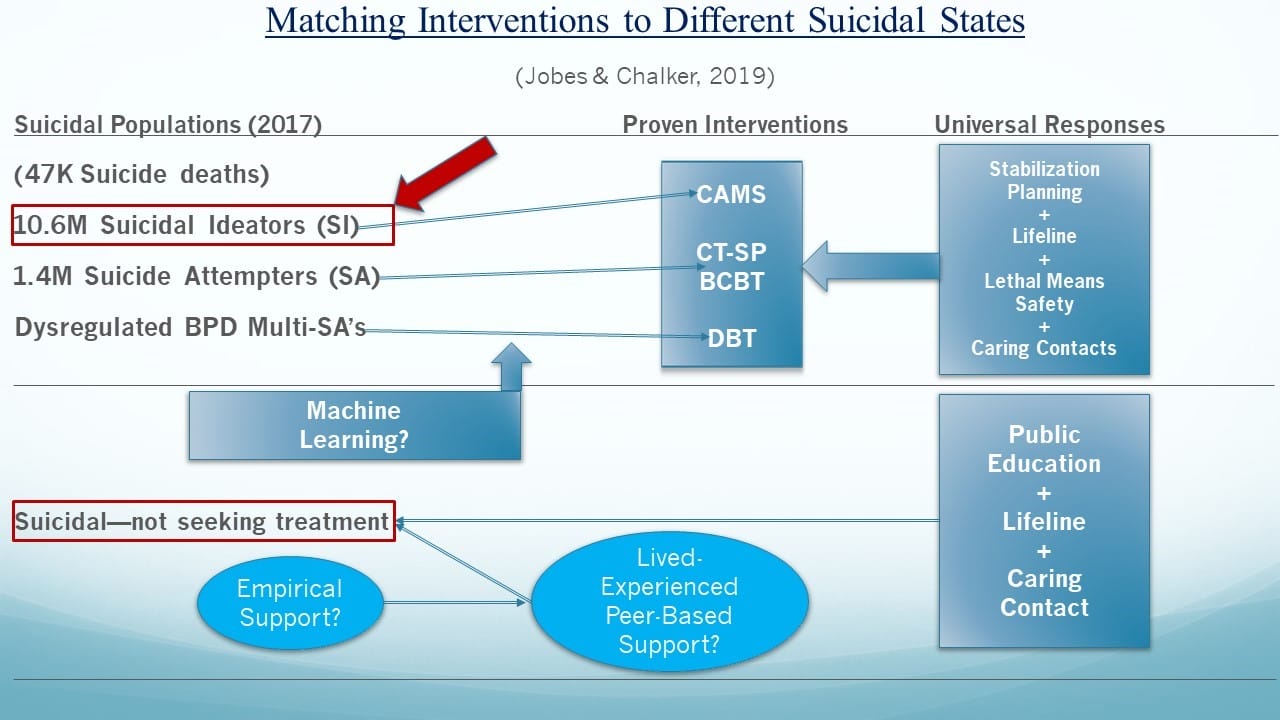
Despite the aforementioned concerns, we believe that the notion of prescriptive suicide-focused treatments is now increasingly possible. As shown in the lower half of Figure 1, the discussion begins with suicidal people who do not want to seek professional care. As we noted, this population make up the majority of the suicidal population. We can aspire to educate, provide access to the National Lifeline, and if they touch healthcare systems, perhaps we can endeavor to provide caring follow-up.

However, beyond these largely public health-oriented approaches, we do not know exactly how to reach this group. Perhaps the evolving lived-experience perspective and peer-support movement can provide a more accessible and less stigmatizing approach for this population.

Cams-care Image

Figure 1. Different suicidal states include suicidal ideators (SI), suicide attempters (SAs), and multiple SAs. For those that seek mental health care: (SI) may be best matched to the Collaborative Assessment and Management of Suicidality (CAMS), SAs may be best matched to Cognitive Therapy for Suicide Prevention (CT-SP) or Brief Cognitive Behavior Therapy (BCBT), and dysregulated individuals with borderline personality disorder (BPD) with a multiple SA history may be best matched to Dialectical Behavior Therapy (DBT). Those that are suicidal but do not seek mental health treatment may be best matched to those with live-experienced and peer-based supports. Lifeline = the United States national suicide prevention lifeline phone number: 1-800-273-TALK (8255).

Considering the upper half of the Figure 1, for those suicidal people seeking mental health care, in an ideal world, machine-learning algorithms could be used to optimally route patients to proven treatments that are best suited to care for different suicidal states—a version of empirically-based prescriptive suicide-focused treatments. It should be noted that similar components (e.g., stabilization planning, lethal means safety, etc.) tend to be integral in each of these effective treatments. As a final note, while focusing on suicide attempts and deaths is important and necessary, we also need to bring more attention to the massive population of seriously suicidal ideators, who represent the figurative iceberg under the water of the suicide prevention challenge, if we want to reduce suicidal attempts and completions [3].

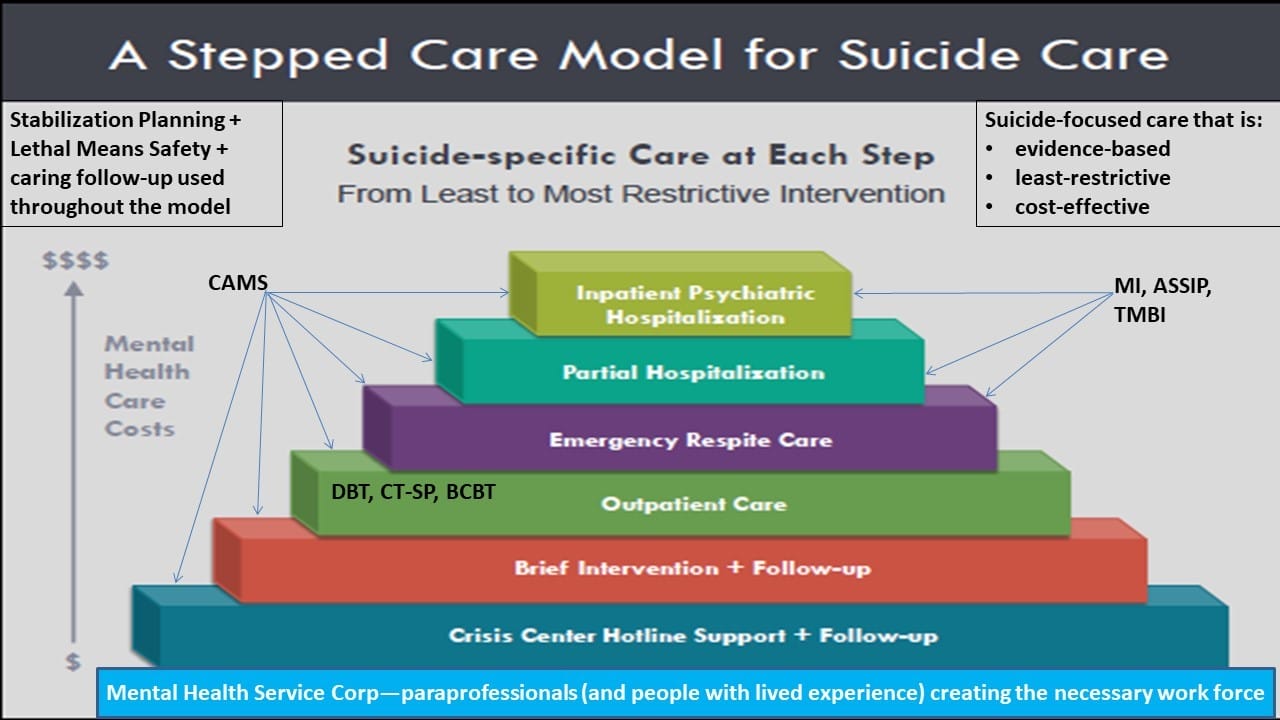
From an even larger perspective, Figure 2 (adapted from an earlier figure that appears in [81]) depicts a “stepped care” model for suicide care. The healthcare costs, represented on the y-axis, are probably the single biggest force shaping healthcare practices in the real world. To this end, the top of the pyramid notes the most expensive systems-level interventions (i.e., inpatient psychiatric hospitalization) down to the least expensive interventions nearer the bottom of the pyramid. Moreover, the bottom layer reflects the need to grow a massive paraprofessional community of caring people who are trained to work with people at risk. Jobes has therefore called for the development of a “National Mental Health Service Corps” (similar to the United States Peace Corps founded in the 1960s) that could create a large community of volunteers and (or) provide caring individuals who could serve in a range of capacities, such as screening and peer-based support with proper training and supervision [82]. There will never be enough clinical providers to meet the needs of 10.6 million adults with serious suicidal thoughts (in the United States example). Indeed, such personnel could provide much needed care on the National Lifeline, which is currently facing significant capacity issues.

Cams-care Image

Figure 2. The y-axis is mental health care costs; the steps of the pyramid correspond from the bottom to the top with the least restrictive intervention the most restrictive intervention. ASSIP = Attempted Suicide Short Intervention Program; BCBT = Brief Cognitive Behavior Therapy; CAMS = Collaborative Assessment and Management of Suicidality; CT-SP = Cognitive Therapy for Suicide Prevention; DBT = Dialectical Behavior Therapy; MI = Motivational Interviewing; PACT = Post Admission Cognitive Therapy; TMBI = Teachable Moment Brief Intervention.

As we move up the levels of systems within the pyramid, the use of different evidence-based treatments described in this article can be layered in each level of clinical care. Ultimately this stepped care model provides a way of thinking broadly to providing cost-effective, least-restrictive, evidence-based care for those at risk for suicide. If we truly aim to make a lifesaving difference, public and mental policy shaped by this kind of approach might make a meaningful difference by reducing suicides and suicide-related suffering in all its forms.

Summary and Conclusions

We have argued in this article that to move the field of mental health forward in terms of suicidal risk, we must move away from a “one-size-fits-all” approach to working with suicidal people. Rather, an approach that matches different evidence-based suicide-focused treatments (i.e., DBT, CT-SP, BCBT, and CAMS) to different suicidal states is clearly needed. We also need thoughtful conceptual models and progressive evidence-based policies (e.g., Zero Suicide) to optimally engage those suicidal people who do not seek care. Finally, an array of professional and paraprofessional approaches (e.g., including the support of those with lived experience) and various services are needed to better support those people who battle with suicidal thoughts, feelings, and behaviors.

Conflicts of Interest: David Jobes has conflicts to disclose related to grant funding from the National Institute of Mental Health and the American Foundation for Suicide Prevention; he receives book royalties from the American Psychological Association Press and Guilford Press; and he is the founder of CAMS-care, LLC (a professional training and consultation company). Samantha Chalker has no conflicts to disclose.

  1. Jobes, D.A. Clinical assessment and treatment of suicidal risk: A critique of contemporary care and CAMS as a possible remedy. Pract. Innov. 2017, 2, 207–220. [CrossRef]
  2. Jobes, D.A. One size does not fit all: Matching empirically proven interventions to different suicidal states. In Proceedings of the American Association of Suicidology, Denver, CO, USA, 24–27 April 2019.
  3. Dweck, C. Mindset: Changing the Way You Think to Fulfil Your Potential; Hachette UK: London, UK, 2012.
  4. Stanley, B.; Brown, G.K. Safety planning intervention: A brief intervention to mitigate suicide risk. Cogn. Behav. Pract. 2012, 19, 256–264. [CrossRef]
  5. Stanley, B.; Brown, G.K.; Brenner, L.A.; Galfalvy, H.C.; Currier, G.W.; Knox, K.L.; Chaudhury, S.R.; Bush, A.L.; Green, K.L. Comparison of the Safety Planning Intervention with Follow-up vs. Usual Care of Suicidal Patients Treated in the Emergency Department. JAMA Psychiatry 2018, 75, 894–900.
  6. Rudd, M.D.; Joiner, T.E.; Rajab, M.H. Treating Suicidal Behavior: An Effective, Time-Limited Approach; Guilford Press: New York, NY, USA, 2004.
  7. Bryan, C.J.; Corso, K.A.; Neal-Walden, T.A.; Rudd, M.D. Managing suicide risk in primary care: Practice recommendations for behavioral health consultants. Prof. Psychol. Res. Pract. 2009, 40, 148. [CrossRef]
  8. Bryan, C.J.; Mintz, J.; Clemans, T.A.; Burch, T.S.; Leeson, B.; Williams, S.; Rudd, M.D. Effect of crisis response planning on patient mood and clinician decision making: A clinical trial with suicidal US soldiers. Psychiatr. Serv. 2017, 69, 108–111. [CrossRef]
  9. Bryan, C.J.; Mintz, J.; Clemans, T.A.; Leeson, B.; Burch, T.S.; Williams, S.R.; Maney, E.; Rudd, M.D. Effect of crisis response planning vs. contracts for safety on suicide risk in US Army Soldiers: A randomized clinical trial. J. Affect. Disord. 2017, 212, 64–72. [CrossRef] [PubMed]
  10. Rudd, M.D.; Bryan, C.J.; Wertenberger, E.G.; Peterson, A.L.; Young-McCaughan, S.; Mintz, J.; Williams, S.R.; Arne, K.A.; Breitbach, J.; Delano, K.; et al. Brief cognitive-behavioral therapy effects on post-treatment suicide attempts in a military sample: Results of a randomized clinical trial with 2-year follow-up. Am. J. Psychiatry 2015, 172, 441–449. [CrossRef] [PubMed]
  11. Rudd, M.D.; Mandrusiak, M.; Joiner, T.E. The case against no-suicide contracts: The commitment to treatment statement as a practice alternative. J. Clin. Psychol. 2006, 62, 243–251. [CrossRef] [PubMed]
  12. Jobes, D.A. Managing Suicidal Risk: A Collaborative Approach; Guilford Press: New York, NY, USA, 2006.
  13. Jobes, D.A. Managing Suicidal Risk: Second Edition: A Collaborative Approach, 2nd ed.; Guilford Press: New York, NY, USA, 2016.
  14. Motto, J.A.; Bostrom, A.G. A randomized controlled trial of post crisis suicide prevention. Psychiatr. Serv. 2001, 52, 828–833. [CrossRef] [PubMed]
  15. Reger, M.A.; Luxton, D.D.; Tucker, R.P.; Comtois, K.A.; Keen, A.D.; Landes, S.J.; Matarazzo, B.B.; Thompson, C. Implementation methods for the caring contacts suicide prevention intervention. Prof. Psychol. Res. Pr. 2017, 48, 369–377. [CrossRef]
  16. Luxton, D.D.; June, J.D.; Comtois, K.A. Can post discharge follow-up contacts prevent suicide and suicidal behavior? Crisis 2012, 46–47. [CrossRef] [PubMed]
  17. Comtois, K.A.; Kerbrat, A.H.; DeCou, C.R.; Atkins, D.C.; Majeres, J.J.; Baker, J.C.; Ries, R.K. Effect of augmenting standard care for military personnel with brief caring text messages for suicide prevention: A randomized clinical trial. JAMA Psychiatry 2019, 76, 474–483.[PubMed]
  18. Carey, B. Expert on mental illness reveals her own struggle. New York Times. Available online: https://www.sadag.org/images/pdf/expert%20own%20fight.pdf (accessed on 29 August 2019).
  19. Hogan, M.F.; Grumet, J.G. Suicide prevention: An emerging priority for health care. Health Aff. 2016, 35, 1084–1090. [CrossRef]
  20. Dimeff, L.A.; Jobes, D.A.; Chalker, S.A.; Piehl, B.M.; Duvivier, L.L.; Lok, B.C.; Zalake, M.S.; Chung, J.; Koerner, K. A novel engagement of suicidality in the emergency department: Virtual Collaborative Assessment and Management of Suicidality. Gen. Hosp. Psychiatry 2018. [CrossRef]
  21. Bruffaerts, R.; Demyttenaere, K.; Hwang, I.; Chiu, W.T.; Sampson, N.; Kessler, R.C.; Alonso, J.; Borges, G.; de Girolamo, G.; de Graaf, R.; et al. Treatment of suicidal people around the world. Br. J. Psychiatry 2011, 199, 64–70. [CrossRef]
  22. Alexander, M.J.; Haugland, G.; Ashenden, P.; Knight, E.; Brown, I. Coping with thoughts of suicide: Techniques used by consumers of mental health services. Psychiatr. Serv. 2009, 60, 1214–1221. [CrossRef]
  23. Allen, M.H.; Carpenter, D.; Sheets, J.L.; Miccio, S.; Ross, R. What do consumers say they want and need during a psychiatric emergency? J. Psychiatr. Pract. 2003, 9, 39–58. [CrossRef] [PubMed]
  24. Aguirre, R.T.P.; Slater, H.M. Suicide postvention as suicide prevention: Improvement and expansion in the United States. Death Stud. 2010, 34, 529–540. [CrossRef] [PubMed]
  25. Begley, M.; Quayle, E. The lived experience of adults bereaved by suicide: A phenomenological study. Crisis 2007, 28, 26–34. [CrossRef] [PubMed]
  26. Force, S.A. The Way Forward: Pathways to Hope, Recovery, and Wellness with Insights from Lived Experience; National Action Alliance for Suicide Prevention: Washington, DC, USA, 2014.
  27. Crisis Now. 2019. Available online: https://crisisnow.com (accessed on 29 August 2019).
  28. Live Through This. 2019. Available online: https://livethroughthis.org (accessed on 29 August 2019).
  29. Now Matters Now. 2019. Available online: https://www.nowmattersnow.org (accessed on 29 August 2019).
  30. MacLean, S.; MacKie, C.; Hatcher, S. Involving people with lived experience in research on suicide prevention. CMAJ 2018, 190, S13–S14. [CrossRef] [PubMed]
  31. The Joint Commission. Sentinel Event Alert: Detecting and treating suicide ideation in all settings. Jt. Comm. 2016, 56, 1–7.
  32. Brodsky, B.S.; Spruch-Feiner, A.; Stanley, B. The zero suicide model: Applying evidence-based suicide prevention practices to clinical care. Front. Psychiatry 2018, 9, 33. [CrossRef] [PubMed]
  33. Zero Suicide. 2019. Available online: https://zerosuicide.sprc.org (accessed on 29 August 2019).
  34. National Suicide Action Alliance for Suicide Prevention: Transforming Health Systems Initiative Work Group. Recommended Standard Care for People with Suicide Risk: Making Health Care Suicide Safe; Education Development Center, Inc.: Washington, DC, USA, 2018.
  35. Durkheim, E. Suicide: A Study in Sociology, 1987; Spaulding, J.A.; Simpson, G., Translators; Free Press: Glencoe, IL, USA, 1951.
  36. Conrad, A.K.; Jacoby, A.M.; Jobes, D.A.; Lineberry, T.W.; Shea, C.E.; Arnold Ewing, T.D.; Schmid, P.J.; Ellenbecker, S.M.; Lee, J.L.; Fritsche, K.; et al. A psychometric investigation of the suicide status form II with a psychiatric inpatient sample. Suicide Life Threat. Behav. 2009, 39, 307–320.[PubMed]
  37. Kleiman, E.M.; Turner, B.J.; Fedor, S.; Beale, E.E.; Huffman, J.C.; Nock, M.K. Examination of real-time fluctuations in suicidal ideation and its risk factors: Results from two ecological momentary assessment studies. J. Abnorm. Psychol. 2017, 126, 726. [CrossRef] [PubMed]
  38. Au, J.S. Typologies of Suicidal Patients Based on Suicide Status Form Data. Ph.D. Thesis, The Catholic University of America, Washington, DC, USA, 2019.
  39. Stanley, I.H.; Rufino, K.A.; Rogers, M.L.; Ellis, T.E.; Joiner, T.E. Acute suicidal affective disturbance (ASAD): A confirmatory factor analysis with 1442 psychiatric inpatients. J. Psychiatr. Res. 2016, 80, 97–104. [CrossRef]
  40. Galynker, I.; Yaseen, Z.S.; Cohen, A.; Benhamou, O.; Hawes, M.; Briggs, J. Prediction of suicidal behavior in high risk psychiatric patients using an assessment of acute suicidal state: The suicide crisis inventory. Depress. Anxiety 2017, 34, 147–158. [CrossRef] [PubMed]
  41. Jobes, D.A. The challenge and the promise of clinical suicidology. Suicide Life Threat. Behav. 1995, 25, 437–449. [PubMed]
  42. Kessler, R.C.; Chalker, S.A.; Luedtke, A.R.; Sadikova, E.; Jobes, D.A. A preliminary precision treatment rule for collaborative assessment and management of suicidality relative to enhanced care-as-usual in prompting rapid remission of suicide ideation. Behav. Res. Ther. 2019. [CrossRef]
  43. Bridge, J.A.; Iyengar, S.; Salary, C.B.; Barbe, R.P.; Birmaher, B.; Pincus, H.A.; Ren, L.; Brent, D.A. Clinical response and risk for reported suicidal ideation and suicide attempts in pediatric antidepressant treatment: A meta-analysis of randomized controlled trials. JAMA 2007, 297, 1683–1696. [PubMed]
  44. Gysin-Maillart, A.; Schwab, S.; Soravia, L.; Megert, M.; Michel, K. A novel brief therapy for patients who attempt suicide: A 24-months follow-up randomized controlled study of the attempted suicide short intervention program (ASSIP). PLoS Med. 2016, 13, e1001968. [CrossRef] [PubMed]
  45. Bateman, A.; Fonagy, P. 8-year follow-up of patients treated for borderline personality disorder: Mentalization-based treatment versus treatment as usual. Am. J. Psychiatry 2008, 165, 631–638. [CrossRef] [PubMed]
  46. Linehan, M. Cognitive-Behavioral Treatment for Borderline Personality Disorder; Guilford Press: New York, NY, USA, 1993.
  47. Linehan, M.M.; Comtois, K.A.; Murray, A.M.; Brown, M.Z.; Gallop, R.J.; Heard, H.L.; Korslund, K.E.; Tutek, D.A.; Reynolds, S.K.; Lindenboim, N. Two-year randomized controlled trial and follow-up of dialectical behavior therapy vs therapy by experts for suicidal behaviors and borderline personality disorder. Arch. Psychiatry 2006, 63, 757–766.
  48. Linehan, M.M.; Korslund, K.E.; Harned, M.S.; Gallop, R.J.; Lungu, A.; Neacsiu, A.D.; McDavid, J.; Comtois, K.A.; Murray-Gregory, A.M. Dialectical behavior therapy for high suicide risk in individuals with borderline personality disorder: A randomized clinical trial and component analysis. JAMA Psychiatry 2015, 72, 475–482.
  49. Goldstein, T.R.; Fersch-Podrat, R.K.; Rivera, M.; Axelson, D.A.; Merranko, J.; Yu, H.; Brent, D.A.; Birmaher, B. Dialectical behavior therapy for adolescents with bipolar disorder: Results from a pilot randomized trial. J. Child Adole. Psychopharm. 2015, 25, 140–149. [CrossRef]
  50. Mehlum, L.; Ramberg, M.; Tørmoen, A.J.; Haga, E.; Diep, L.M.; Stanley, B.H.; Miller, A.L.; Sund, A.M.; Grøholt, B. Dialectical behavior therapy compared with enhanced usual care for adolescents with repeated suicidal and self-harming behavior: Outcomes over a one-year follow-up. J. Am. Acad. Child Adole. Psychiatry 2016, 55, 295–300. [CrossRef]
  51. DeCou, C.R.; Comtois, K.A.; Landes, S.J. Dialectical behavior therapy is effective for the treatment of suicidal behavior: A meta-analysis. Behav. Ther. 2019, 50, 60–72. [CrossRef] [PubMed]
  52. Brown, G.K.; Have, T.T.; Henriques, G.R.; Xie, S.X.; Hollander, J.E.; Beck, A.T. Cognitive therapy for the prevention of suicide attempts: A randomized controlled trial. JAMA 2005, 294, 563–570.[PubMed]
  53. Beck, A.T.; Kovacs, M.; Weissman, A. Hopelessness and suicidal behavior: An overview. JAMA 1975, 234, 1146–1149.[PubMed]
  54. Beck, A.T. The current state of cognitive therapy: A 40-year retrospective. Arch. Gen. Psychiatry 2005, 62, 953. [PubMed]
  55. Comtois, K.A.; Jobes, D.A.; O’Connor, S.; Atkins, D.C.; Janis, K.; Chessen, C.; Landes, S.J.; Holen, A.; Yuodelis-Flores, C. Collaborative assessment and management of suicidality (CAMS): Feasibility trial for next-day appointment services. Depress. Anxiety 2011, 28, 963–972. [CrossRef] [PubMed]
  56. Jobes, D.A.; Comtois, K.A.; Gutierrez, P.M.; Brenner, L.A.; Huh, D.; Chalker, S.A.; Ruhe, G.; Kerbrat, A.H.; Atkins, D.C.; Jennings, K.; et al. A randomized controlled trial of the collaborative assessment and management of suicidality versus enhanced care as usual with suicidal soldiers. Psychiatry 2017, 80, 339–356. [CrossRef] [PubMed]
  57. Ryberg, W.; Zahl, P.H.; Diep, L.M.; Landrø, N.I.; Fosse, R. Managing suicidality within specialized care: A randomized controlled trial. J. Affect. Disord. 2019, 249, 112–120. [CrossRef]
  58. Andreasson, K.; Krogh, J.; Wenneberg, C.; Jessen, H.K.L.; Krakauer, K.; Gluud, C.; Thomsen, R.R.; Randers, L.; Nordentoft, M. Effectiveness of dialectical behavior therapy versus collaborative assessment and management of suicidality treatment for reduction of self-harm in adults with borderline personality traits and disorder: A randomized observer-blinded clinical trial. Depress. Anxiety 2016, 33, 520–530. [CrossRef] [PubMed]
  59. Luoma, J.B.; Martin, C.E.; Pearson, J.L. Contact with mental health and primary care providers before suicide: A review of the evidence. Am. J. Psychiatry 2002, 159, 909–916. [CrossRef]
  60. Niederkrotenthaler, T.; Logan, J.E.; Karch, D.L.; Crosby, A. Characteristics of US suicide decedents in 2005–2010 who had received mental health treatment. Psychiatr. Serv. 2014, 65, 387–390. [CrossRef]
  61. Pitman, A.; Osborn, D.P.J. Cross-cultural attitudes to help-seeking among individuals who are suicidal: New perspective for policymakers. Br. J. Psychiatry 2011, 199, 8–10. [CrossRef] [PubMed]
  62. Jobes, D.A.; Gregorian, M.J.; Colborn, V.A. A stepped care approach to clinical suicide prevention. Psychol. Serv. 2018, 15, 243. [CrossRef] [PubMed]
  63. Jobes, D.A.; Kelly, C.A. Growing up in AAS. Presented at the American Association of Suicidology, Phoenix, AZ, USA, 21 April 2017.

About the Author

David A. Jobes Ph.D. ABPP

David A. Jobes Ph.D. ABPP
David Jobes, PhD, ABPP, is the founder of CAMS-care, LLC. He began his career in 1987 in the Counseling Center of the Catholic University of America, where he developed a suicide risk assessment tool for college students that evolved into CAMS. Dr. Jobes is now a Professor of Psychology and Associate Director of Clinical Training at Catholic; he has trained thousands of mental health professionals in the United States and abroad in evidence-based assessment and treatment of suicide risk and the use of CAMS.

About David A. Jobes Ph.D. ABPP

David A. Jobes Ph.D. ABPP
David Jobes, PhD, ABPP, is the founder of CAMS-care, LLC. He began his career in 1987 in the Counseling Center of the Catholic University of America, where he developed a suicide risk assessment tool for college students that evolved into CAMS. Dr. Jobes is now a Professor of Psychology and Associate Director of Clinical Training at Catholic; he has trained thousands of mental health professionals in the United States and abroad in evidence-based assessment and treatment of suicide risk and the use of CAMS.

One Size Does Not Fit All – Part 2: Key Developments in Suicide Prevention

Full article originally published September 26, 2019 in International Journal of Environmental Research and Public Health

Key Developments in Suicide Prevention May Be Changing Mindsets

There are various contemporary developments that may help workers in the field to move from a fixed mindset about hospitalization and medications for all suicidal individuals to a growth mindset, which is supported by the extant RCT evidence-base and enhanced and evidence-based clinical practices, which can be further supported by progressive mental health policy.

Suicide Intervention Strategies & Stabilization Planning

Perhaps one of the most important developments over the past 20 years in clinical suicidology has been the development and use of different versions of suicide-focused interventions that focus on stabilization planning for prospective acute suicidal crises. In marked contrast to the coercive and unfortunate use of “No-Harm Contracts” or “No-Suicide Contracts,” various stabilization planning interventions for suicidal outpatients are intuitively more compelling and have proven effective in clinical trial research. The best known of these interventions is the Safety Plan Intervention (SPI) developed by Drs. Stanley and Brown [23]. Widely adopted in the American Veterans Affairs and the U.S. Department of Defense healthcare systems, the SPI has also been adopted in the public and private sectors as an alternative to coercive contracts that focus on what a patient promises not to do (i.e., kill themselves) versus planning for what they will do within a suicidal, dark moment of crisis. The Safety Plan guides the patient through the steps of identifying triggers, self-coping techniques, distraction by others, reaching out for supportive help, reaching out to professional help, and securing lethal means. Many have clinically embraced the Safety Plan Intervention early on as an intuitively better option to coercive no-suicide contracts (despite the absence of empirical support for so doing). Relatively recently however, the superiority of the SPI over no-harm contracting for reducing suicide attempt behaviors was clearly demonstrated [24] in a large cohort-comparison study of suicidal U.S. military veterans, and additional randomized controlled trial data are now being conducted.

A conceptual “cousin” of the SPI is the “Crisis Response Plan” (CRP), which was first developed by Rudd, Joiner, and Rajab [25] and further elaborated and rigorously studied by Bryan and colleagues [26–30]. The CRP has the patient note on an index card, in their own written words, various triggers, coping strategies, resources, and oftentimes their reasons for living. Bryan and colleagues [28] performed a convincing RCT comparing the CRP to no-harm contracts and showed a significant effect on both suicidal ideation and suicide attempts, reducing the latter by 76% at the six-month follow-up assessment.

Another variation on this theme is the CAMS Stabilization Plan, which is developed in the initial session of the Collaborative Assessment and Management of Suicidality (CAMS) [31,32]. Within this therapeutic framework, the CSP emphasizes securing lethal means, which is followed by a list of coping strategies, resources for outreach, ways for decreasing isolation, and potential barriers to attending CAMS-guided clinical care. The CSP has not been independently studied outside of its use within CAMS, but it is a crucial tool that is routinely used within this evidence-based suicide-focused clinical treatment.

Caring Letters for Suicide Prevention

A rather stunning research development occurred when psychiatrist Jerome Motto had the idea of sending a “caring letter” to post-discharged psychiatric patients who refused to seek further mental health treatment. In their now famous RCT, Motto and Bostrom [33] found that sending a simple letter expressing concern and care every four months to patients post-discharge over five years caused a reduction in suicides, when compared to patients who did not receive caring letters. This elegantly simple study has been a transformative discovery for the field.

Motto’s seminal work has led to various replications using different forms of “caring contacts” that have involved different versions of the original Motto idea of using letters. Indeed, this simple, inexpensive and scalable intervention has been investigated using postcards, letters, emails, and text messages [34]. While some data have been mixed, a larger review of published caring contact trials found it to be generally effective in reducing suicidal behaviors [35]. Nevertheless, these authors noted the need for more rigorous caring contact RCTs. To this end, a recent RCT [36] with suicidal military personnel using caring contacts via text messages was compared to treatment as usual. The investigators found that those receiving caring contacts via text message were less likely to have any suicidal ideation and fewer attempts from baseline to 12 months. However, the likelihood or severity of suicidal ideation and the number of suicide risk incidents (i.e., hospitalization or medical evacuation) were not significantly different between groups.

Lived Experience Perspective

It is hard to estimate the impact of people who have “lived experience” with suicidal thoughts, attempts, and encounters with conventional mental health care. Among the earliest pioneers in this area were American Terri Wise and Australian Keith Harris. Marsha Linehan is perhaps the most famous person to poignantly describe her extensive experiences when she was a highly suicidal teenager [37]. In any case, there can be no question that the lived experience movement has had a significant impact on suicide prevention policy making [38], emerging clinical practices, and research Lived Experience Peer-Support Movement (e.g., [39])

Effectiveness of Lived Experience Peer-Support

The World Health Organization’s World Mental Health Survey determined that across 21 nations, a majority of individuals thinking, planning, and attempting suicide do not receive clinical treatments [40]. The major barriers for suicidal individuals to seek mental health care include low perceived need, attitudes to treatment (e.g., the wish to handle it on one’s own), and practical concerns (e.g., financial concerns). Given these considerations, there is a recognition of the need for other possible ways for suicidal individuals to relieve their suffering beyond traditional primary or psychiatric care [40].

A survey on how suicidal individuals cope with their suicidal thoughts showed overwhelmingly that talking with someone who was not a mental health professional was the primary response. Only 12% of respondents included talking to someone in the mental health profession [41]. Given these data, Alexander and colleagues [41] have advocated for education and support for family and peers as another line of intervention for loved ones in crisis. A desire for increased peer support services as a way to improve care was also noted among consumers who experienced a psychiatric emergency [42]. This research highlighted the desire for peer support to improve emergency care in a variety of situations including during physical restraint, being referred to a post-discharge peer support group, and assistance in securing post-discharge services. Some mental health policy advocates are now promoting various peer-support services as part of a compelling alternative to our contemporary current clinical practices within emergency services (refer to: https://crisisnow.com/#core_elements).

Generally speaking, those with lived experience have personally had suicidal thoughts, feelings, and/or engaged in suicidal behavior(s). Importantly, people with lived experience are also willing to share their experiences with others as they advocate for better mental health care and encourage others with lived experience to participate in their efforts to reform care for suicidal risk [43,44]. The emergence of this perspective is underscored by multiple national and international organizations who have devoted web link resources to support people with lived experience (e.g., the Suicide Prevention Resource Center, Zero Suicide, American Foundation for Suicide Prevention, National Action Alliance for Suicide Prevention, National Alliance of Mental Illness, Centre for Suicide Prevention, American Association of Suicidology, and International Association for Suicide Prevention).

At the national policy level in the U.S., the Suicide Attempt Survivors Task Force of the National Action Alliance for Suicide Prevention has published “The Way Forward: Pathways to Hope, Recovery, and Wellness with Insights from Lived Experience” [45]. This landmark report focuses on suicide prevention practices that are evidenced-based while also incorporating personal testimonies of those with lived experience.

Lived experience advocates are now being promoted in many diverse areas to assist in the prevention of suicide. For instance, those with lived experience have created web pages (e.g., NowMattersNow.org; LiveThroughThis.org; CrisisNow.org) to document their experiences and also provide help to those seeking alternative treatments [46–48]. Help that is provided on these websites includes video testimonies and skills (e.g., dialectical behavior therapy skills). Moreover, lived experience participants have been included in randomized controlled trials to provide added support to more traditional “face-to-face” talk therapy. One study that examined men who presented to the emergency department for self-harm demonstrated that research studies can readily include individuals with lived experience [49]. A community can be formed around such a research project to provide long-lasting support within patient-centered research to offer an innovative way to reach more high-risk individuals [49].

Suicide Policy Developments

Over the past twenty years in the United States, there have been some notable suicide-specific policies that have significantly changed suicide-related clinical practices. By their very nature, these policies are designed to shift practitioners from a status quo approach to handling suicidal risk to utilizing alternative practices that are largely driven by empirical data.

Joint Commission Sentinel Event Alerts

The Joint Commission (TJC) accredits well over 21,000 healthcare settings across the United States. Because suicide-related fatal outcomes have been among the leading “sentinel events” (i.e., failures in care resulting in adverse outcomes), TJC has issued various Sentinel Event Alerts to notify accredited institutions that certain practices must change and be observed in accreditation site visits or possible sanctions may ensue. To the surprise of some within the healthcare industry, TJC issued a Sentinel Event Alert entitled “Detecting and Treating Suicide Ideation in all Settings” [50]. While the particular alert has been re-framed as “aspirational” (versus a required expectation), their intent is plain: take suicide seriously, identify the risk, and treat it.

Zero Suicide Initiative

Inspired by the work of the Clinical Care Task Force of the National Action Alliance, the “Zero Suicide” policy initiative has been game changing in terms of an A-Z approach to raising the clinical standard of care across systems of care by developing the following: leadership, training, assessment, identification (assessment), engagement, treatment, transition, and improvement [51,52]. While there has been some controversy connected to the name, there can be no arguing the abject success. Zero Suicide policies are embraced across the United States and now around the world. It is fair to say there is no policy initiative in the history of suicide prevention that has been more influential and impactful than Zero Suicide (see discussion by [38]).

Recommended Standard Care

There has been little guidance about how to best meet clinical expectations for effective care of suicidal patients. In the United States, the Substance Abuse and Mental Health Services Administration (SAMHSA) sponsored a working group to develop affordable and evidence-based approaches to working with suicidal risk across outpatient, inpatient, and emergency department settings. The “Recommended Standard Care for People with Suicide Risk: Making Health Care Suicide Safe” document [53] recommends basic approaches to working with suicidal patients, primarily emphasizing: identification/assessment of risk, stabilization/safety planning, lethal means safety discussions, the National Suicide Prevention Lifeline, and caring contact follow-up (all addressed throughout this article).

The Pursuit of Suicidal Typologies

Since the birth of suicide research, the determined pursuit of suicidal typologies has been a major focus of the field. Perhaps the most notable initial attempt was by sociologist Emile Durkheim in his classic work Le Suicide in 1897 [54]. Durkheim posited that there were four distinct suicide typologies as a function of social integration: egoistic, altruistic, anomic, and fatalistic. One example of this model is a World War II soldier who heroically throws himself on a live grenade within combat to save the lives of his comrades in arms—a clear example of an altruistic suicide. Many psychological typologies have ensued over the following years. In recent times, acute and chronic states have been empirically established [55]. Advanced technology has been used in ecological momentary assessment (EMA) to identify six reliable and distinct patterns of suicidal thinking [56]. Latent profile analysis can be used to identify distinct types of suicidal patients [57]. Within the realm of diagnostic nosology, Joiner and colleagues have proposed a potential DSM-6 candidate diagnosis called “Acute Suicidal Affective Disturbance” [58]. Similarly, Galynker and colleagues [59] have proposed the “Suicide Crisis Syndrome.”

The pursuit of reliable typologies is particularly relevant when clinical treatments are considered. Indeed, Jobes argued many years ago for the pursuit of “prescriptive” treatments, that is, matching different interventions to different suicidal states [60]. The notion of routing certain suicidal patients to certain well-suited treatments was once considered a pipedream, however, the contemporary reality of this prospect is a central assertion within this article.

Machine Learning and Predicting Suicide

Another way to think about suicidal typologies is a rapidly emerging and exciting—albeit sometimes controversial—approach that is broadly referred to as “machine learning” (which is sometimes referred to as “big data” research). As described by Kessler, et al. [61], the goals of “precision medicine” are to understand how the effects of treatment are modified by patient characteristics and to develop “precision treatment rules” (PTRs) based on this understanding to determine which of the treatments under consideration is likely to yield the best outcome for each patient or fine-grained patient subgroup.


  1. Stanley, B.; Brown, G.K. Safety planning intervention: A brief intervention to mitigate suicide risk. Cogn. Behav. Pract. 2012, 19, 256–264. [CrossRef]
  2. Stanley, B.; Brown, G.K.; Brenner, L.A.; Galfalvy, H.C.; Currier, G.W.; Knox, K.L.; Chaudhury, S.R.; Bush, A.L.; Green, K.L. Comparison of the Safety Planning Intervention with Follow-up vs. Usual Care of Suicidal Patients Treated in the Emergency Department. JAMA Psychiatry 2018, 75, 894–900.
  3. Rudd, M.D.; Joiner, T.E.; Rajab, M.H. Treating Suicidal Behavior: An Effective, Time-Limited Approach; Guilford Press: New York, NY, USA, 2004.
  4. Bryan, C.J.; Corso, K.A.; Neal-Walden, T.A.; Rudd, M.D. Managing suicide risk in primary care: Practice recommendations for behavioral health consultants. Prof. Psychol. Res. Pract. 2009, 40, 148. [CrossRef]
  5. Bryan, C.J.; Mintz, J.; Clemans, T.A.; Burch, T.S.; Leeson, B.; Williams, S.; Rudd, M.D. Effect of crisis response planning on patient mood and clinician decision making: A clinical trial with suicidal US soldiers. Psychiatr. Serv. 2017, 69, 108–111. [CrossRef]
  6. Bryan, C.J.; Mintz, J.; Clemans, T.A.; Leeson, B.; Burch, T.S.; Williams, S.R.; Maney, E.; Rudd, M.D. Effect of crisis response planning vs. contracts for safety on suicide risk in US Army Soldiers: A randomized clinical trial. J. Affect. Disord. 2017, 212, 64–72. [CrossRef] [PubMed]
  7. Rudd, M.D.; Bryan, C.J.; Wertenberger, E.G.; Peterson, A.L.; Young-McCaughan, S.; Mintz, J.; Williams, S.R.; Arne, K.A.; Breitbach, J.; Delano, K.; et al. Brief cognitive-behavioral therapy effects on post-treatment suicide attempts in a military sample: Results of a randomized clinical trial with 2-year follow-up. Am. J. Psychiatry 2015, 172, 441–449. [CrossRef] [PubMed]
  8. Rudd, M.D.; Mandrusiak, M.; Joiner, T.E. The case against no-suicide contracts: The commitment to treatment statement as a practice alternative. J. Clin. Psychol. 2006, 62, 243–251. [CrossRef] [PubMed]
  9. Jobes, D.A. Managing Suicidal Risk: A Collaborative Approach; Guilford Press: New York, NY, USA, 2006.
  10. Jobes, D.A. Managing Suicidal Risk: Second Edition: A Collaborative Approach, 2nd ed.; Guilford Press: New York, NY, USA, 2016.
  11. Motto, J.A.; Bostrom, A.G. A randomized controlled trial of post crisis suicide prevention. Psychiatr. Serv. 2001, 52, 828–833. [CrossRef] [PubMed]
  12. Reger, M.A.; Luxton, D.D.; Tucker, R.P.; Comtois, K.A.; Keen, A.D.; Landes, S.J.; Matarazzo, B.B.; Thompson, C. Implementation methods for the caring contacts suicide prevention intervention. Prof. Psychol. Res. Pr. 2017, 48, 369–377. [CrossRef]
  13. Luxton, D.D.; June, J.D.; Comtois, K.A. Can post discharge follow-up contacts prevent suicide and suicidal behavior? Crisis 2012, 46–47. [CrossRef] [PubMed]
  14. Comtois, K.A.; Kerbrat, A.H.; DeCou, C.R.; Atkins, D.C.; Majeres, J.J.; Baker, J.C.; Ries, R.K. Effect of augmenting standard care for military personnel with brief caring text messages for suicide prevention: A randomized clinical trial. JAMA Psychiatry 2019, 76, 474–483.[PubMed]
  15. Carey, B. Expert on mental illness reveals her own struggle. New York Times. Available online: https://www.sadag.org/images/pdf/expert%20own%20fight.pdf (accessed on 29 August 2019).
  16. Hogan, M.F.; Grumet, J.G. Suicide prevention: An emerging priority for health care. Health Aff. 2016, 35, 1084–1090. [CrossRef]
  17. Dimeff, L.A.; Jobes, D.A.; Chalker, S.A.; Piehl, B.M.; Duvivier, L.L.; Lok, B.C.; Zalake, M.S.; Chung, J.; Koerner, K. A novel engagement of suicidality in the emergency department: Virtual Collaborative Assessment and Management of Suicidality. Gen. Hosp. Psychiatry 2018. [CrossRef]
  18. Bruffaerts, R.; Demyttenaere, K.; Hwang, I.; Chiu, W.T.; Sampson, N.; Kessler, R.C.; Alonso, J.; Borges, G.; de Girolamo, G.; de Graaf, R.; et al. Treatment of suicidal people around the world. Br. J. Psychiatry 2011, 199, 64–70. [CrossRef]
  19. Alexander, M.J.; Haugland, G.; Ashenden, P.; Knight, E.; Brown, I. Coping with thoughts of suicide: Techniques used by consumers of mental health services. Psychiatr. Serv. 2009, 60, 1214–1221. [CrossRef]
  20. Allen, M.H.; Carpenter, D.; Sheets, J.L.; Miccio, S.; Ross, R. What do consumers say they want and need during a psychiatric emergency? J. Psychiatr. Pract. 2003, 9, 39–58. [CrossRef] [PubMed]
  21. Aguirre, R.T.P.; Slater, H.M. Suicide postvention as suicide prevention: Improvement and expansion in the United States. Death Stud. 2010, 34, 529–540. [CrossRef] [PubMed]
  22. Begley, M.; Quayle, E. The lived experience of adults bereaved by suicide: A phenomenological study. Crisis 2007, 28, 26–34. [CrossRef] [PubMed]
  23. Force, S.A. The Way Forward: Pathways to Hope, Recovery, and Wellness with Insights from Lived Experience; National Action Alliance for Suicide Prevention: Washington, DC, USA, 2014.
  24. Crisis Now. 2019. Available online: https://crisisnow.com (accessed on 29 August 2019).
  25. Live Through This. 2019. Available online: https://livethroughthis.org (accessed on 29 August 2019).
  26. Now Matters Now. 2019. Available online: https://www.nowmattersnow.org (accessed on 29 August 2019).
  27. MacLean, S.; MacKie, C.; Hatcher, S. Involving people with lived experience in research on suicide prevention. CMAJ 2018, 190, S13–S14. [CrossRef] [PubMed]
  28. The Joint Commission. Sentinel Event Alert: Detecting and treating suicide ideation in all settings. Jt. Comm. 2016, 56, 1–7.
  29. Brodsky, B.S.; Spruch-Feiner, A.; Stanley, B. The zero suicide model: Applying evidence-based suicide prevention practices to clinical care. Front. Psychiatry 2018, 9, 33. [CrossRef] [PubMed]
  30. Zero Suicide. 2019. Available online: https://zerosuicide.sprc.org (accessed on 29 August 2019).
  31. National Suicide Action Alliance for Suicide Prevention: Transforming Health Systems Initiative Work Group. Recommended Standard Care for People with Suicide Risk: Making Health Care Suicide Safe; Education Development Center, Inc.: Washington, DC, USA, 2018.
  32. Durkheim, E. Suicide: A Study in Sociology, 1987; Spaulding, J.A.; Simpson, G., Translators; Free Press: Glencoe, IL, USA, 1951.
  33. Conrad, A.K.; Jacoby, A.M.; Jobes, D.A.; Lineberry, T.W.; Shea, C.E.; Arnold Ewing, T.D.; Schmid, P.J.; Ellenbecker, S.M.; Lee, J.L.; Fritsche, K.; et al. A psychometric investigation of the suicide status form II with a psychiatric inpatient sample. Suicide Life Threat. Behav. 2009, 39, 307–320. [PubMed]
  34. Kleiman, E.M.; Turner, B.J.; Fedor, S.; Beale, E.E.; Huffman, J.C.; Nock, M.K. Examination of real-time fluctuations in suicidal ideation and its risk factors: Results from two ecological momentary assessment studies. J. Abnorm. Psychol. 2017, 126, 726. [CrossRef] [PubMed]
  35. Au, J.S. Typologies of Suicidal Patients Based on Suicide Status Form Data. Ph.D. Thesis, The Catholic University of America, Washington, DC, USA, 2019.
  36. Stanley, I.H.; Rufino, K.A.; Rogers, M.L.; Ellis, T.E.; Joiner, T.E. Acute suicidal affective disturbance (ASAD): A confirmatory factor analysis with 1442 psychiatric inpatients. J. Psychiatr. Res. 2016, 80, 97–104. [CrossRef]
  37. Galynker, I.; Yaseen, Z.S.; Cohen, A.; Benhamou, O.; Hawes, M.; Briggs, J. Prediction of suicidal behavior in high risk psychiatric patients using an assessment of acute suicidal state: The suicide crisis inventory. Depress. Anxiety 2017, 34, 147–158. [CrossRef] [PubMed]
  38. Jobes, D.A. The challenge and the promise of clinical suicidology. Suicide Life Threat. Behav. 1995, 25, 437–449. [PubMed]
  39. Kessler, R.C.; Chalker, S.A.; Luedtke, A.R.; Sadikova, E.; Jobes, D.A. A preliminary precision treatment rule for collaborative assessment and management of suicidality relative to enhanced care-as-usual in prompting rapid remission of suicide ideation. Behav. Res. Ther. 2019. [CrossRef]

About the Author

David A. Jobes Ph.D. ABPP

David A. Jobes Ph.D. ABPP
David Jobes, PhD, ABPP, is the founder of CAMS-care, LLC. He began his career in 1987 in the Counseling Center of the Catholic University of America, where he developed a suicide risk assessment tool for college students that evolved into CAMS. Dr. Jobes is now a Professor of Psychology and Associate Director of Clinical Training at Catholic; he has trained thousands of mental health professionals in the United States and abroad in evidence-based assessment and treatment of suicide risk and the use of CAMS.

About David A. Jobes Ph.D. ABPP

David A. Jobes Ph.D. ABPP
David Jobes, PhD, ABPP, is the founder of CAMS-care, LLC. He began his career in 1987 in the Counseling Center of the Catholic University of America, where he developed a suicide risk assessment tool for college students that evolved into CAMS. Dr. Jobes is now a Professor of Psychology and Associate Director of Clinical Training at Catholic; he has trained thousands of mental health professionals in the United States and abroad in evidence-based assessment and treatment of suicide risk and the use of CAMS.

One Size Does Not Fit All – Part 1: A Comprehensive Approach to Suicide Prevention

Full article originally published September 26, 2019 in International Journal of Environmental Research and Public Health

The Problem: Suicide is a Major Public Health Issue

Suicide accounts for almost 800,000 deaths per year [1] around the world. In the United States suicide is the 10th leading cause of death with approximately 47,000 total deaths in 2017 and 1.4 million American adults attempted suicide in that same year [2]. While suicidologists and public health officials are understandably preoccupied with suicide deaths and suicide attempts, Jobes and Joiner [3] have recently reflected on the massive population of people who experience suicidal ideation and all too often escape the attention of our suicide prevention research, clinical treatments, and even national health care policies. In the United States, 10,600,000 American adults experience serious suicidal thoughts [4]—a worrisome cohort that dwarfs the populations of those who attempt and die by suicide.

To fully address the many challenges to clinical suicide risk reduction we will consider: the history of mental health care and its legacy for suicidal patients, the notion of mindsets about how to best help care for suicidal people, various contemporary developments that may be changing mindsets about clinical suicide prevention, the historic pursuit of suicidal typologies, evidence-based suicide-focused treatments, and finally a stepped care public health model.

History of Suicide Prevention

The history of the field of mental health and the treatment of suicidal patients is rather sordid and includes many disturbing developments over the years. Prior to European enlightenment, the mentally ill were largely understood to be deviants possessed by the devil and (or) evil spirits; religious exorcisms were frontline “treatments” [5]. It is interesting to note that some form of ritual exorcism exists across the major world religions (e.g., Christianity, Judaism, Hinduism, and Islam). It was not until the latter 18th century that mentally ill “lunatics” began to be understood and treated with more compassion as patients with an illness. The innovative French doctor Phillippe Pinel famously ordered in 1795 that mentally ill patients be released from their chains at a large asylum named la Salpetriere outside of Paris. This launched the notion of “moral treatment,” which helped change perceptions about mental illness and how such people with these illnesses should be treated [6]. Unfortunately, the continued association of mental illness with “asylums” of this era and in the years that followed does not seem either enlightened or particularly moral.

Early “treatments” of the mentally ill were crude and physically harmful (e.g., bloodletting and trephination—the drilling of holes in the cranium) [5]. Various methods of inducing seizures or comas were explored and collectively referred to as shock therapies in the early 20th century [7]. There was extensive experimentation using electricity that ultimately resulted in the development of electro-convulsive therapy (ECT), which in the present day has been found to be helpful as a last resort for patients with treatment-resistant, severe depression [8]. Massive doses of insulin were repeatedly administered to patients with schizophrenia to induced comas—insulin coma therapy (ICT) [9]. Behavior-altering surgeries such as lobotomies and cingulotomies were used often in the mid-20th century to control patient behavior [5].

Psychopharmacology Treatment of Suicidal Patients

Psychiatric care of the mentally ill took a notable turn in the 1950s with the advent of first-generation antipsychotic medications. The evolution of psychotropic medications has been extensive and has come to shape the prevailing assumptions about suicidal patients—that treating a mental disorder is the key to reducing the symptoms of suicidal ideation and behavior.

While medications have undoubtedly helped many who suffer from mental disorders, there is extensive evidence that targeting and treating mental disorders has little or mixed impact on suicidal risk [10–12]. Despite the widespread use of medication, there is fairly limited data (based on randomized controlled trials—RCTs) about the efficacy of medicine on suicidality [13]. For example, the emergent use of ketamine on suicidal ideation for a few days [14] has short-lived for some suicidal patients. There is meta-analytic support for lithium carbonate among suicidal bipolar patients [15] and one un-replicated RCT has shown that clozapine can reduce suicidal ideation and attempts among thought-disordered patients [16]. Data on the effectiveness of anti-depressants with suicidal risk are quite mixed [10]. Notably, there are now three meta-analyses showing that treating mental disorders has little to no impact on suicidal ideation and behavior [10–12]. Notwithstanding the lack of evidence, prominent experts (e.g., [17]) insist on the primacy of treating mental disorders to reduce suicidal risk, even trivializing the effectiveness of suicide-focused psychological treatments that have been proven to work by replicated data from rigorous randomized controlled trials.

Legacy of Mental Health

So, what is the legacy of our history of managing and treating mentally ill people? On the one hand, humanity has been able to move from superstition and fantastic explanations for abnormal behavior to a more clinical and interventive approach. On the other hand, the legacy has created a “doctor knows best” mentality marked by a custodial, coercive, and paternal model that largely centers on controlling behaviors, by force if necessary. Relevant to our present consideration of the suicidal patient, a further remnant of this history is the idea that suicidal people belong in the hospital and that being suicidal is by definition “crazy,” so we must therefore treat this particular form of insanity. There are of course consequences to such considerations. Indeed, there is evidence that negative views of inpatient psychiatric care and fear of being hospitalized may compel suicidal patients to not be forthright with their clinical provider about their suicidal thoughts [18]. Moreover, insisting on the pre-eminence of treating mental disorders (particularly using only medicine) for suicidal risk defies the extensive evidence-base that supports the effectiveness of targeting and treating suicidal ideation and behaviors independently of psychiatric diagnoses (refer to [19]).

A Fixed Mindset about Suicidal Patient Care?

To be balanced and fair, we agree that countless suicidal people have likely been helped by inpatient psychiatric care and psychotropic medications. Nevertheless, the previously discussed lack of suicide-specific evidence is rather striking. To this end, Jobes has argued that some contemporary providers may make assumptions about the presumed effectiveness of inpatient care and the use of medicine on suicidal risk [20]. Importantly, such presumptions can have a major impact on the patient’s clinical disposition, and even the course of their entire life. What is particularly concerning is that some clinicians may find themselves not always working in the patient’s best interest due to countertransference issues or fear of litigation should a patient take their life. In turn, such issues and fears may lead to overly defensive practices (e.g., hospitalizing a patient who has passive suicidal thoughts). Moreover, such practice behaviors may be shaped by wishful thinking that a three to six-day hospital stay or that treating the mental disorder with medicine is actually more effective for suicidal risk than alternative approaches that are supported by the data.

Thus, there may be a misguided notion that a “one-size” approach (i.e., a brief hospitalization and medication to treat the disorder) will work for all suicidal patients [21]. Another way of understanding the possible insistence by some that these approaches are effective can be explained by Stanford psychologist Carol Dweck’s [22] notion of a psychological “mindset.” Dweck’s empirical work has shown the existence of two distinct mindsets: a “fixed” mindset versus a “growth” mindset. Her research shows how these mindsets are reliably associated with different outcomes for personal and professional success, and a growth mindset is much more adaptive and linked to successful outcomes.

Given this line of thinking, is it possible that many mental health providers have developed a certain fixed mindset about what is best for a suicidal person? It is hard for anyone to say with certainty, but in our view, the effective assessment and treatment of suicidal risk requires a growth mindset so that we are better able to embrace suicide-focused approaches that are supported by RCT evidence. Also, we must collectively develop a growth mindset at the public health policy level to fully appreciate that a “one-size” approach to suicidality does not sufficiently address the worldwide challenge of suicidal risk [21].

  1. References World Health Organization. Suicide Rates (Per 100,000 Population); World Health Organization: Geneva, Switzerland, 2019.
  2. Drapeau, C.W.; McIntosh, J.L. USA Suicide 2017: Official Final Data; Official final data; American Association of Suicidology: Washington, DC, USA, 2018.
  3. Jobes, D.A.; Joiner, T.E. Reflections on suicidal ideation. Crisis J. Crisis Interv. Suicide Prev. 2019, 40, 227–230. [CrossRef] [[PubMed]]
  4. SAMHSA 2017 study (2018): Center for Behavioral Health Statistics and Quality. Key Substance Use and Mental Health Indicators in the United States: Results from the 2017 National Survey on Drug Use and Health; (HHS Pub. No. SMA 17-5068, NSDUH Series H-53); Substance Abuse and Mental Health Services Administration: Rockville, MD, USA, 2018.
  5. Farreras, I.G. History of mental illness. In Noba Textbook Series: Psychology; Biswas-Diener, R., Diener, E., Eds.; DEF Publishers: Champaign, IL, USA, 2019.
  6. Micale, M.S. The Salpêtrière in the age of Charcot: An institutional perspective on medical history in the late nineteenth century. J. Contemp. Hist. 1985, 20, 703–731. [CrossRef] [PubMed]
  7. Neustatter, W.L. Modern psychiatry in practice. Ment. Health 1948, 7, 105.
  8. Pagnin, D.; de Queiroz, V.; Pini, S.; Cassa, G.B. Efficacy of ECT in depression: A meta-analytic review. J. ECT 2004, 20, 13. [CrossRef]
  9. Jones, K. Insulin coma therapy in schizophrenia. J. R. Soc. Med. 2000, 93, 147–149. [CrossRef] [PubMed]
  10. Braun, C.; Bschor, T.; Franklin, J.; Baethge, C. Suicides and suicide attempts during long-term treatment with antidepressants: A meta-analysis of 29 placebo-controlled studies including 6934 patients with major depressive disorder. PPS 2016, 85, 171–179.
  11. Cuijpers, P.; de Beurs, D.P.; van Spijker, B.A.; Berking, M.; Andersson, G.; Kerkhof, A.J. The effects of psychotherapy for adult depression on suicidality and hopelessness: A systematic review and meta-analysis. J. Affect. Disord. 2013, 144, 183–190. [CrossRef]
  12. Jakobsen, J.C.; Katakam, K.K.; Schou, A.; Hellmuth, S.G.; Stallknecht, S.E.; Leth-Møller, K.; Iversen, M.; Banke, M.B.; Petersen, I.J.; Klingenberg, S.L.; et al. Selective serotonin reuptake inhibitors versus placebo in patients with major depressive disorder. A systematic review with meta-analysis and Trial Sequential Analysis. BMC Psychiatry 2017, 17, 58.
  13. Zalsman, G.; Hawton, K.; Wasserman, D.; Van Heeringen, K.; Arensman, E.; Sarchiapone, M.; Carli, V.; Höschl, C.; Barzilay, R.; Balazs, J.; et al. Suicide prevention strategies revisited: 10-year systematic review. Lancet Psychiatry 2016, 3, 646–659. [CrossRef]
  14. Murrough, J.W.; Soleimani, L.; DeWilde, K.E.; Collins, K.A.; Lapidus, K.A.; Iacoviello, B.M.; Lener, M.; Kautz, M.; Kim, J.; Stern, J.B.; et al. Ketamine for rapid reduction of suicidal ideation: A randomized controlled trial. Psychol. Med. 2015, 45, 3571–3580. [CrossRef]
  15. Cipriani, A.; Pretty, H.; Hawton, K.; Geddes, J.R. Lithium in the prevention of suicidal behavior and all-cause mortality in patients with mood disorders: A systematic review of randomized trials. Am. J. Psychiatry 2005, 162, 1805–1819. [CrossRef] [PubMed]
  16. Meltzer, H.Y.; Alphs, L.; Green, A.I.; Altamura, A.C.; Anand, R.; Bertoldi, A.; Bourgeois, M.; Chouinard, G.; Islam, M.Z.; et al. Clozapine treatment for suicidality in schizophrenia: International suicide prevention trial (InterSePT). Arch. Gen. Psychiatry 2003, 60, 82–91.[PubMed]
  17. Hoge, C.W. Suicide reduction and research efforts in service members and veterans—Sobering realities. JAMA Psychiatry 2019, 76, 464–466.[PubMed]
  18. Blanchard, M.; Farber, B.A. ‘It is never okay to talk about suicide’: Patients’ reasons for concealing suicidal ideation in psychotherapy. Psychother. Res. 2018, 1–13. [CrossRef] [PubMed]
  19. Jobes, D.A.; Au, J.S.; Siegelman, A. Psychological approaches to suicide treatment and prevention. Curr. Treat. Options Psychiatry 2015, 2, 363–370. [CrossRef]
  20. Jobes, D.A. Clinical assessment and treatment of suicidal risk: A critique of contemporary care and CAMS as a possible remedy. Pract. Innov. 2017, 2, 207–220. [CrossRef]
  21. Jobes, D.A. One size does not fit all: Matching empirically proven interventions to different suicidal states. In Proceedings of the American Association of Suicidology, Denver, CO, USA, 24–27 April 2019.
  22. Dweck, C. Mindset: Changing the Way You Think to Fulfil Your Potential; Hachette UK: London, UK, 2012.

About the Author

David A. Jobes Ph.D. ABPP

David A. Jobes Ph.D. ABPP
David Jobes, PhD, ABPP, is the founder of CAMS-care, LLC. He began his career in 1987 in the Counseling Center of the Catholic University of America, where he developed a suicide risk assessment tool for college students that evolved into CAMS. Dr. Jobes is now a Professor of Psychology and Associate Director of Clinical Training at Catholic; he has trained thousands of mental health professionals in the United States and abroad in evidence-based assessment and treatment of suicide risk and the use of CAMS.

About David A. Jobes Ph.D. ABPP

David A. Jobes Ph.D. ABPP
David Jobes, PhD, ABPP, is the founder of CAMS-care, LLC. He began his career in 1987 in the Counseling Center of the Catholic University of America, where he developed a suicide risk assessment tool for college students that evolved into CAMS. Dr. Jobes is now a Professor of Psychology and Associate Director of Clinical Training at Catholic; he has trained thousands of mental health professionals in the United States and abroad in evidence-based assessment and treatment of suicide risk and the use of CAMS.

5 Approaches When Working with Mental Health Minority Clients

Addressing Mental Health Disparities Among Minorities

24-year-old Violet Blue is a suicidal, transgender Mexican-American client at her initial appointment with Dr. Green to address her suicidal behavior. Dr. Green, a 54-year-old European-American, has been a practicing clinician for over 25 years and is considered an expert in his field. However, his clientele is predominately white males, and Violet is his first encounter working with anyone from the transgender and/or Mexican-American communities. To be honest, Dr. Green is feeling a little apprehensive and nervous about working with Violet. He doesn’t want to say anything that could be interpreted as offensive. Dr. Green tells himself to ignore these feelings and proceed as he would regularly do with his other clients – after all, we should be “colorblind” and treat everyone equally, right?

Let’s listen in on how this first visit goes:

Dr. Green: Violet, I am aware of your history of suicidal behavior and depression. I want to dive into the root causes of this. When did the suicide attempts and depression start?

Violet: I don’t know. I’m uncomfortable.

Dr. Green: Therapy can be uncomfortable, for everyone. It’s important that you immerse yourself in this experience so we can address your problems. When did the suicidal behavior and depression start?

Violet: Ok. I guess when I was seven and realized I was born in the wrong body. I told my family and they said something was wrong with me.

Dr. Green: You are referring to feeling transgender?

Violet: Yes, to being trans.

40 minutes later…

Dr. Green: OK, let’s move on to your treatment plan. I want to create a treatment plan to address your suicidal behavior. I have a homework assignment and next week we can discuss your progress.

In this brief fictional scenario, we encounter a clinician who is clearly uncomfortable working with his client, which causes him to unintentionally harm the therapeutic relationship. First, when Violet shares that she is uncomfortable, Dr. Green dismisses her discomfort by generalizing her experience and not addressing how she, specifically, feels. As Violet explains her history with suicidal behavior and depression, Dr. Green diminishes her identity (“feeling transgender”) and then quickly moves on from the topic. We start to see how Dr. Green’s discomfort is projected onto the session. He allows his nervousness and inexperience to drive the situation – which in his case means avoiding the subject of her identity. Lastly, Dr. Green informs Violet of a treatment plan, but throughout the process, Violet is delegated to backseat passenger rather than co-pilot. Her experiences are invalidated, and she is not allowed to play an active role in her recovery.

When treating suicidal clients, we often sculpt out our treatment plan within a larger framework of suicide research and practice, providing a universal treatment plan without considering the nuances of an individual’s identity that may influence their suicidal behavior. This creates an atmosphere in which the client becomes uncomfortable with the therapeutic process, lessening the bond between the client and therapist and rendering services less effective.

Working with clients belonging to marginalized and minority communities (e.g., LGBTQ, women, racial & religious minorities, etc.) presents a challenge to the modern psychologist. While the psychology workforce is becoming increasingly diverse, racial/ethnic and LGBTQ psychologists are still a minority within research and practice.1

With the majority of both caregivers and patients in the white male category, anyone who does not fit into the majority becomes the ‘other’. The ‘other’ becomes the invisible, the marginalized, and the untreated (or ineffectively treated). When we ‘other’ clients, we invalidate their experience.

5 Effective Approaches when Treating Minority Mental Health

It is important to address the needs of all suicidal clients, including examining the different societal and cultural conditions that influence the identity of an individual. The following are five effective approaches to consider when treating minority clients:

1.  Acknowledge Differences.

When a client discusses experiences as a minority, it is detrimental for the therapist to avoid acknowledging the client’s positionality—the lens through which the world views an individual. Dismissing their individuality contributes to ‘othering’—and to practice a colorblind approach might create an environment where you have invalidated their experiences.

Another important note is that the minority client’s identity could be a contributing factor to their suicidal behavior. For example, a client who is Asian-American might feel isolated navigating their American and Asian identity or they could experience workplace/academic pressures that stem from cultural stressors. Addressing these caveats may improve and increase the effectiveness of treatment.

Equally important is the ability of the therapist to acknowledge their own positionality and examine how that impacts the therapeutic relationship. Minority clients may express difficulties when being treated by white therapists.2 They may feel isolated or disempowered by the heightened, unbalanced power dynamics created by systematic marginalization. To acknowledge and discuss these fears builds trust in the therapeutic relationship.

2.  Validate Experiences.

 As discussed in the first approach, minority clients might feel that their daily experiences are often overlooked, marginalized, and invalidated. As important as it is to acknowledge their experiences, it is equally important to validate them. For example, a suicidal gay client might confide to their therapist feelings of social alienation and rejection due to continued prejudices against gay people. These stressors may influence that client’s suicidality.

Affirming the validity of the client’s feelings and experiences is a crucial part of effective treatment. Validation does not simply mean that you understand or agree, it is the act of letting your client know that you acknowledge, recognize, and support their experiences.

3.  Accept Your Limitations.

Transparency as a therapist is an important skill to develop. Let’s be honest, working with minority clients can be intimidating without a background in or experience working with these communities. What if you say the wrong words and appear insensitive – or worse, prejudice?

Your trepidation is valid, and during the right circumstances, discussing these limitations with the client may ease anxiety on both sides. For example, during an initial session treating a black client, a white therapist might observe discomfort and hesitation from the client or experience their own hesitation. Openly addressing your own limitations and the client’s anxiety builds trust and honesty between the client and therapist.

4.  Use a Collaborative Approach.

The collaborative approach uses a model in which the client and therapist work together to create and implement a treatment plan. This plan is tailored to the client’s unique challenges and strengths. This process helps to create a more egalitarian relationship in which the client is respected as the expert on their experiences and the therapist as the expert on the treatment.

This approach is crucial to treating suicidal behavior because many suicidal clients express feelings of hopelessness and powerlessness. A collaborative approach provides them with the tools to begin to change the predicament and re-establish power to oneself.

Working through this therapeutic process, the client and therapist begin to build rapport and trust, and control is placed in the client’s hands. This is important, because suicidal minority clients especially may feel powerless and hopeless. Creating an environment for a safe space where the individual feels a part of something may help reduce some of the symptoms.

5.  Inquire about their Community Support System.

To many minority clients, the family and community unit is an essential part of their healing and stabilization processes. Having a support system can play a big role in the responsiveness of a client and the effectiveness of treatment. For instance, an African American client might be hesitant to disclose suicidal behavior due to community and cultural ideologies about suicide. A transgender client might be more open towards the therapeutic process if they have supportive family and friends that validate their expression of self.

Community support systems are complex aspects of a client’s life, and learning about these structural systems (or lack thereof) will help the therapist better address the client’s needs.

Clinician and Suicidal Minority Client Scenario

Now that we have become familiar with more healthy approaches to working with minority clients, let’s recreate the fictional scenario between Dr. Green and Violet Blue:

Dr. Green: Violet, I am aware of your history of suicidal behavior and depression. I want to dive into the root causes of this. When did the suicide attempts and depression first start?

Violet: I don’t know. I’m uncomfortable.

Dr. Green: Yes, I understand. Sometimes the therapeutic process can be uncomfortable, and that is valid. I want us to address this discomfort, so we can improve our working relationship and your treatment. Violet, would you mind sharing why you feel uncomfortable?

Violet: I guess. Sometimes it’s hard seeing therapists who don’t understand what it’s like to be a trans Chicana. My last therapist just didn’t get me. It was a waste of time.

Dr. Green: Violet, thank you for sharing with me. I am an old, white guy and to be honest, I have limited experience working with trans… Chicana? I’m not familiar with the term. Can you explain it to me?

Violet: It’s what us Mexican-American women call ourselves.

Dr. Green: Thanks for the clarification. I was not familiar with Chicana, but now it will become a part of my vocabulary. Thank you. I have limited experience working with trans Chicana women. However, I do understand suicide and I want to help you with your recovery. I hope to work with you to get a better understanding of your identity, culture and suicidal behavior. There are sometimes references that I might not understand, but it’s important for both of us to acknowledge these differences and work together. What do you think?

Violet: Yeah, we can do that. Thanks.

Dr. Green: Great. Thank you, Violet. Addressing your suicidal behavior and history with depression, can we go back to when you first started feeling this way?

Violet: I guess it was when I was 7 and realized I was born in the wrong body. I told my family and they said something waswrong with me.

Dr. Green: I can imagine that experience was hard for you. I can assure you there is nothing wrong with your identity. Does your family still think the same way about you?

Violet: Thanks. Some of them don’t, but my mom is very supportive, and I have really great friends in the transcommunity.

Dr. Green: I’m glad that you have a good support system through your mom and friends. I think incorporating their support into the treatment plan will be very beneficial.

Violet: Yeah, I agree.

Dr. Green: Wonderful. I would like us to sit together and discuss a treatment plan that would be right for you. I am thinking about a range of approaches that might be best. We can discuss more about what is the options are and what treatment will lookl ike. Would you like us to do that?

Violet: Yes. That sounds good.

In this re-created scenario, Dr. Green provides a welcoming space that is conducive to building trust and improving the therapeutic process. First, when Violet shares her discomfort, he addresses her concerns and shares his limitations. Sharing his own discomfort shows Violet that Dr. Green is honest and truly cares about helping her. This time, he validates her experience when he individualizes her discomfort and re-assures her identity as a transgender Chicana woman. Even when he was confused about terminology related to her identity, he addressed those limitations.

As Violet discusses her background and support system, Dr. Green follows up with questions to assess how to include her support system within the treatment plan. Throughout the session, Dr. Green uses a collaborative approach by allowing Violet to be the expert in her experience. He provides her with an understanding of therapy, yet consults her opinion throughout their interaction.

This session is more productive, collaborative, and efficient than the previous one and is a good model of the therapeutic approach that is often used within CAMS – or Collaborative Assessment and Management of Suicidality.

Research suggests that CAMS is effective in treating minority communities.2 A major reason for this effectiveness is the use of the collaborative approach, which centers the client as an expert on navigating their suicidal behavior. The CAMS direct approach to handling suicide-related treatment also provides space for the therapist to practice a more multicultural and humanistic care, allowing for a therapeutic process that:

  • acknowledges the social/cultural differences of the client-therapist dynamic,
  • validates the experiences of the client,
  • allows space for the therapist to acknowledge their limitations,
  • provides a collaborative treatment plan, and
  • seeks to learn about and include the client’s community support system in

These tips can be used within a wide scope of clinical framework, not just CAMS. Throughout my continuous training as a psychology student, I have observed my mentors, supervisors, colleagues, and myself implement these techniques while working with minority clients. As a minority, receiving therapy from a therapist who incorporated these techniques has often alleviated my own apprehension towards the process. When treating mental health — especially suicidal behavior — it is essential to consider the impact of a client’s identity.

Footnotes:

1 American Psychological Association. (2015). Demographics of U.S. Psychological Workforce: Findings from the AmericanCommunity Workforce. [Online pdf]. Retrieved from https://www.apa.org/workforce/publications/13-demographics/report.pdf

2 Jeffrey A. Hayes, Andrew A. McAleavey, Louis G. Castonguay, and Benjamin D. Locke. Psychotherapists’ OutcomesWith White and Racial/Ethnic Minority Clients: First, the Good News. Journal of Counseling Psychology 2016, Vol 63, No 3, pp 261-268. https://www.apa.org/pubs/journals/features/cou-cou0000098.pdf

3 Jayong L. Choi, James R. Rogers, James L. Werth, Jr. Suicide Risk Assessment With Asian American College Students: A CulturallyInformed Perspective. Sage Journals, Vol 37, Issue 2, pp 186-218. https://journals.sagepub.com/doi/10.1177/0011000006292256

About the Author

Tanisha Esperanza Jarvis M.A.

Tanisha Esperanza Jarvis M.A.
Tanisha Esperanza Jarvis received her B.A. in anthropology and sociology at Spelman College in 2015, where she also minored in Comparative Women’s Studies. While at Spelman, her research focused on integrating academia and social justice. As a Bonner Scholar and Social Justice Fellow her research work included preventative and interventional treatment of sexual trauma and LGBTQ and racial/ethnic minority research. She finished her M.A. in psychological sciences from The Catholic University of America (CUA) in 2019. Her research within the Suicide Prevention Lab (SPL) focused on integrating an international approach to CAMS research and treatment of suicidality within marginalized communities.

About Tanisha Esperanza Jarvis M.A.

Tanisha Esperanza Jarvis M.A.
Tanisha Esperanza Jarvis received her B.A. in anthropology and sociology at Spelman College in 2015, where she also minored in Comparative Women’s Studies. While at Spelman, her research focused on integrating academia and social justice. As a Bonner Scholar and Social Justice Fellow her research work included preventative and interventional treatment of sexual trauma and LGBTQ and racial/ethnic minority research. She finished her M.A. in psychological sciences from The Catholic University of America (CUA) in 2019. Her research within the Suicide Prevention Lab (SPL) focused on integrating an international approach to CAMS research and treatment of suicidality within marginalized communities.